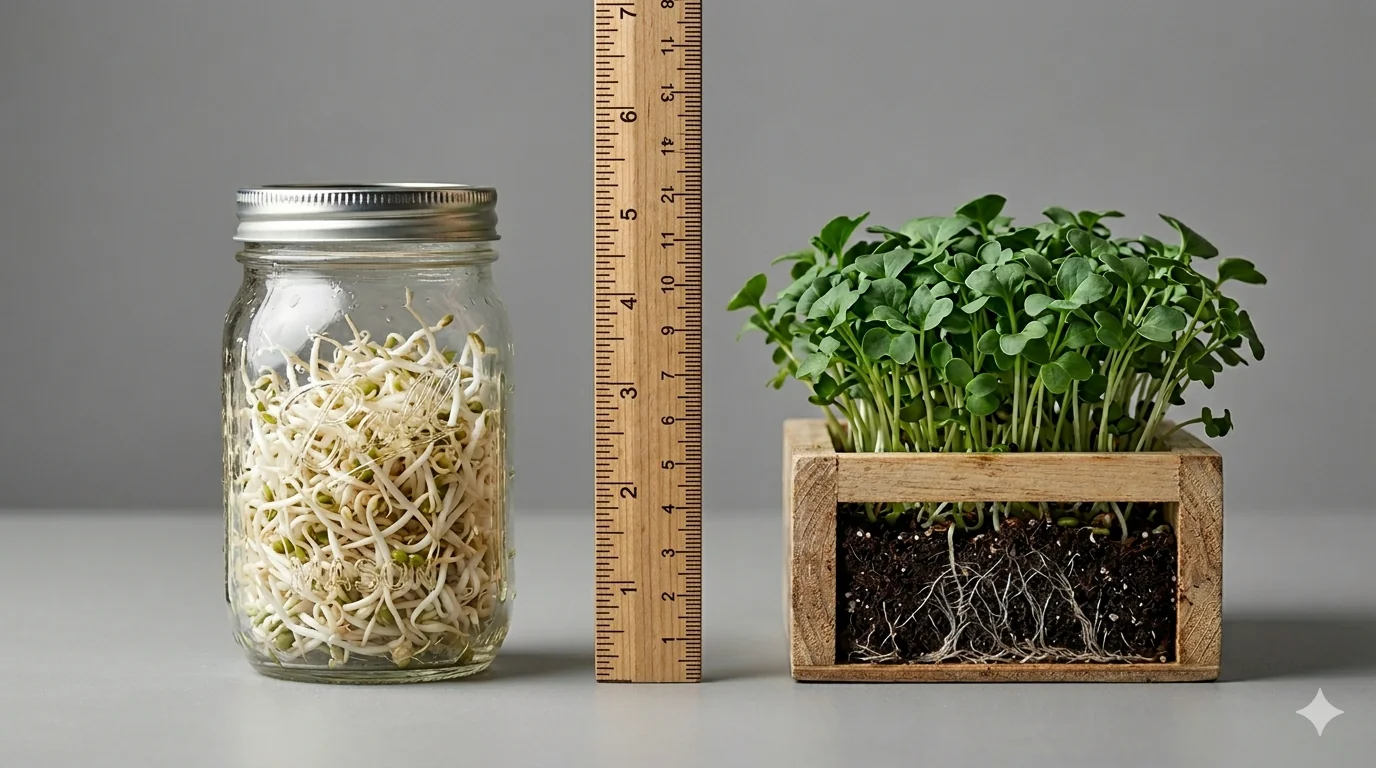
TL;DR 💡
Microgreens are the next stage after sprouts. Microgreens grow in soil and light, are harvested above the soil line (you don't eat the root or seed), and are dramatically safer and more nutrient-dense than sprouts.
People mix up microgreens and sprouts constantly, and it makes sense. They look similar, they are both tiny, and both get marketed as "superfoods." But they are different foods at different growth stages, with very different safety profiles. Here is the honest comparison. 🌿
1. The Quick Side-By-Side 📊
Before we dig into the details, here is the at-a-glance comparison:
| 🌾 Sprouts | 🌱 Microgreens | |
|---|---|---|
| Growth medium | Water (jar or tray) | Soil or soil-like substrate |
| Light needed | No (dark or low light) | Yes (sunlight or LED) |
| Harvest method | Whole plant pulled and rinsed | Cut above soil line |
| What you eat | Seed + root + early shoot | Stem + cotyledon + true leaves |
| Time to harvest | 2 to 5 days | 7 to 21 days |
| Nutrient density | Moderate | High (developed chlorophyll + phytochemicals) |
| Food-safety risk | Higher (CDC outbreak history) | Low |
| Shelf life (fridge) | 2 to 5 days | 1 to 3 weeks (up to 6 with care) |
| Taste | Mild, watery, crunchy | Distinct, full flavor of mature plant |
2. What Are Sprouts? 🌾
A sprout is a freshly germinated seed eaten whole — seed coat, root, and early shoot all together. Sprouts grow in water, usually in a glass jar or shallow tray, with no soil and no light needed. You rinse them a few times a day, and they are ready in 2 to 5 days, well before any true leaves develop.
Common varieties include alfalfa, mung bean, broccoli, lentil, and clover sprouts. Because the entire plant is eaten and harvested while still in its warm, humid germination environment, sprouts go from seed to plate in less than a week.
3. What Are Microgreens? 🌱
A microgreen is the seedling stage of a vegetable or herb, harvested after the cotyledons (seed leaves) and the first true leaves emerge. They grow in soil under light, typically reaching 1 to 3 inches tall in 7 to 21 days depending on the variety.
When microgreens are harvested, they are cut with scissors or a knife above the soil line. You eat only the stem and the leaves — never the seed, never the root. That single difference drives most of what follows: better flavor, better nutrition, and a much safer food product.
4. The Food-Safety Difference ⚠️
This is the single biggest reason most growers and food-safety officials prefer microgreens. Sprouts have a long, well-documented history of foodborne illness outbreaks. According to the CDC and FDA, raw and lightly cooked sprouts have been linked to dozens of E. coli, Salmonella, and Listeria outbreaks in the United States since the mid-1990s.
The reason isn't that sprout farmers are careless. It's the growing environment itself. Sprouts germinate in warm, dark, wet, enclosed conditions — exactly the same conditions that bacteria love. If even a few pathogens are on the seed, they can multiply rapidly during sprouting. That is why the CDC recommends children, pregnant women, older adults, and anyone with a weakened immune system avoid eating raw or lightly cooked sprouts.
Microgreens grow in a fundamentally different environment: soil, airflow, sunlight or full-spectrum LEDs, cooler temperatures, and an open tray rather than a sealed jar. They don't sit in standing water. They are cut above the soil line, so the root and any soil-borne microbes stay with the spent tray. The result is a vastly lower contamination risk, and microgreens have an excellent food-safety record. That isn't a knock on sprouts — it's just biology.
5. Nutrient Density Comparison 💪
Sprouts are nutritious — let's give credit where it's due. Germination breaks down anti-nutrients in the seed and makes certain minerals more bioavailable. But on a per-ounce basis, microgreens generally win, and it's not close.
The reason is simple: microgreens have spent an extra 1 to 3 weeks in the light building chlorophyll, vitamins, carotenoids, and phytochemicals. A landmark 2012 study in the Journal of Agricultural and Food Chemistry found that microgreens contain up to 4 to 40 times the levels of vitamins K, C, E, and beta-carotene compared to their mature counterparts. Sprouts, harvested before light exposure and true-leaf development, never get to build those compounds at the same density.
If you want to dig into the math, see our breakdown of why 1 ounce of microgreens can equal 2 pounds of mature vegetables. 📊
6. Taste & Texture 👅
Sprouts are crunchy, juicy, and mostly mild. Mung bean sprouts are watery and snap clean. Alfalfa is soft and tangly. The flavor is subtle — sprouts are mostly about texture and crunch.
Microgreens have had time to develop the actual flavor of the mature plant, often in a more concentrated form. Radish microgreens have the sharp peppery bite of a full radish. Cilantro microgreens taste like cilantro, dialed up. Sunflower microgreens are nutty and crisp like a lettuce-meets-sunflower-seed cross. Pea shoots taste like fresh garden peas. The flavor range is dramatically wider, which is why chefs love them.
7. Which Should You Eat? 🏆
For most people, most of the time, the answer is microgreens. You get more nutrition per bite, better flavor, longer shelf life, and a much lower food-safety risk. That tradeoff is hard to argue with.
The recommendation gets even stronger for higher-risk groups. Per CDC guidance on raw sprouts, kids, pregnant women, older adults, and anyone immunocompromised should be especially careful with raw sprouts. Microgreens are a safer way to get the same "fresh living greens" benefit without the bacterial risk.
That said, if you love a stir-fry with mung bean sprouts that have been quickly cooked through, that's perfectly reasonable — heat kills the bacteria of concern. Sprouts have a place. Just know what you're choosing.
8. Where to Get Microgreens 🛒
If you're in Southeast Pennsylvania, microGREEN FX grows 27 varieties of microgreens to order and delivers them locally — typically the day after harvest. Browse the shop to see all the varieties, head to the order page to set up a delivery, or grab a grow kit if you'd rather grow them yourself on a kitchen counter.
Try the difference yourself. 🌿
Fresh, soil-grown, light-finished microgreens delivered the day after harvest in SE Pennsylvania.