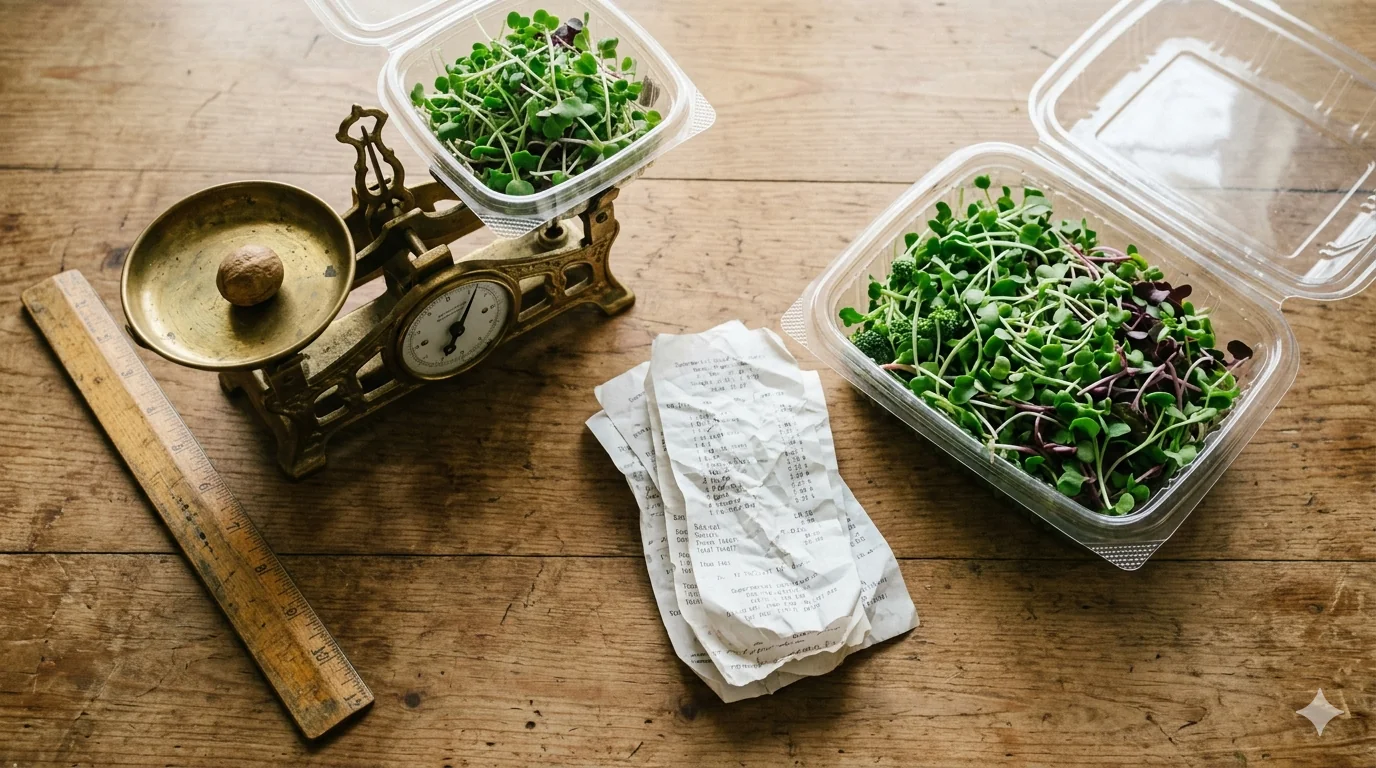
TL;DR
Yes - but only if you eat them. The math: $8 to $12 per ounce delivers the nutrient density of 1 to 2 pounds of mature vegetables. The catch: spoiled produce in your fridge isn't worth anything, and microgreens you don't eat are just expensive trash.
Let's address the elephant in the room. A 4-ounce clamshell of microgreens at the farmers market runs $8 to $12. A pound of organic spinach is $5. On the surface, microgreens look like luxury produce - the kale chip of the salad world. So are they actually worth it, or are you just paying for a pretty garnish?
This is not a sales pitch. We grow microgreens for a living, and we're going to walk through the actual math - including the situations where buying microgreens is a bad financial decision.
1. The Honest Answer - Yes, If You Actually Eat Them
Here's the most important caveat we can give you: microgreens are only worth the money if they end up in your body. Not in the back of your crisper drawer. Not on a "fancy garnish" plate you never make. In your mouth.
We talk to customers every week who order a tray, use it twice, forget it exists, and rediscover it three weeks later. Even though our microgreens last 3 to 6 weeks in the fridge, behavior matters. If you're the kind of person who buys spinach with good intentions and throws out half of it, microgreens won't fix that. They'll just be more expensive spinach you didn't eat.
But if you'll genuinely add a handful to your eggs, sandwich, salad, or smoothie 3 to 5 times a week? The math gets very interesting.
2. The Per-Pound Math: Why Microgreens Look Expensive (and Aren't, Per Nutrient)
Comparing microgreens to spinach by weight is like comparing espresso to drip coffee by volume. You don't drink a 12-ounce mug of espresso. You drink a 1-ounce shot. Concentration changes the unit of comparison.
Peer-reviewed USDA research found microgreens contain 4 to 40 times the vitamin and antioxidant concentration of their mature counterparts. On average, 1 ounce of microgreens delivers the nutrient density of roughly 1 to 2 pounds of mature vegetables (depending on variety and nutrient).
Cost Per "Equivalent Pound of Vegetables"
When you measure cost per actual nutritional payload - not cost per arbitrary unit of weight - microgreens land in roughly the same range as organic produce. Sometimes cheaper. The "expensive" framing only holds up if you ignore concentration.
3. Comparing Cost: Microgreens vs. Multivitamins, Smoothies, & Supplements
Most people who buy microgreens are also spending money on health products. Let's stack them up.
Monthly Cost Comparison
A $30 multivitamin gives you isolated, synthesized nutrients from a factory. A weekly microgreen subscription gives you whole, living plants with the same concentrated micronutrients in their natural matrix - plus fiber, plant compounds, and actual food. We're not going to claim one is medically superior. We will say that for similar money, eating the food version is a defensible choice.
4. The Hidden Cost of Cheap Greens
The $5 bag of grocery store spinach is not actually $5. Here's what most people don't account for:
- 95% water by weight. A pound of mature lettuce is mostly water in cell walls. The dry-matter nutrient payload is small.
- Days to weeks in transit. Most leafy greens are picked, washed, bagged, trucked, warehoused, and shelved before you ever see them. Nutrient degradation begins at harvest.
- Roughly 30 to 40% household waste. The USDA estimates fresh leafy greens are among the most-wasted foods in American homes - much of a bag never gets eaten.
Adjust the $5 bag for waste and degraded nutrient content, and the actual cost per usable, nutritious ounce climbs significantly. Suddenly the $8 microgreen tray that you eat completely - because it stays fresh for weeks - looks less wasteful, not more.
5. Where the Cost Actually Goes
We get asked this constantly: why does a tiny tray cost $8 to $12? Here's the honest breakdown.
What's in a $10 Tray of Microgreens
There's no warehouse, no fleet of refrigerated semis, no shrink-wrap factory. Just seed, soil, water, hands, and a short drive. The price reflects that.
6. The Subscription Math: Why Weekly Costs Less Than One-Off
One-off purchases are the most expensive way to buy microgreens. Here's why a subscription almost always wins on per-ounce cost:
- Free delivery threshold kicks in for recurring orders, eliminating the $5 to $8 per-order delivery fee.
- No waste cycle. A predictable weekly tray gets eaten. A surprise grocery purchase often doesn't.
- Habit formation. Knowing fresh greens land on your doorstep every Tuesday changes what you cook.
- Bulk seed and soil costs drop our per-tray cost on a recurring schedule, which we pass through.
Lock in weekly delivery and stop overpaying
A weekly microGREEN FX subscription unlocks free local delivery and keeps you stocked with farm-fresh microgreens harvested the day they ship. 27 varieties. 3 to 6 week shelf life. Pause or cancel anytime.
Start a Weekly Subscription7. Grow-Your-Own: Even Cheaper If You Have 5 Minutes a Day
We're going to actively talk you out of buying from us in this section, because it's true: growing your own microgreens is the cheapest path. A $30 grow kit yields about 3 harvests, which puts your per-harvest material cost at roughly $10. Refill packs (seeds and soil) drop that further.
The trade-off is time and consistency. You'll spend 5 minutes a day watering, you'll wait 10 to 14 days per cycle, and you'll need a windowsill or a small grow light. If you have those, growing is genuinely cheaper than any subscription on the market.
Try the $30 Grow Kit
3 harvests, organic seeds, custom living soil, and a step-by-step guide. The cheapest entry point to a steady microgreen supply.
Get the $30 Grow Kit8. When Microgreens Aren't Worth It
We'd rather you skip microgreens than waste money on them. Here are the situations where they are genuinely not worth buying:
- You don't like greens. Microgreens are still greens. If kale and arugula make you gag, $10 won't change that.
- You won't actually eat them. If your fridge is a graveyard of good intentions, fix the habit before adding more produce to it.
- You live near abundant cheap local alternatives. If a farm stand down the road sells fresh-pulled spinach at $2 a pound, that's a strong competitor for everyday eating.
- You're trying to feed a family of six on a tight budget. At scale, mature vegetables are cheaper per calorie. Microgreens are a supplement to a vegetable diet, not a replacement.
- You're shopping based on hype, not behavior. If you're buying because Instagram told you to, save the money.
For everyone else - people who like greens, eat them regularly, value local food, and want a high-density nutrient boost without choking down spinach by the pound - microgreens are a defensible spend. The math holds up. The freshness holds up. The shelf life holds up.
Just eat them.
Three ways to get started
Pick the path that matches your life. Subscribe, grow, or join a CSA share - whatever gets actual microgreens into your meals.