⚡ TL;DR
GLAP (Microgreens Grown Like A Pro) is a cross-platform farm operating system written by an operating microgreens farm in Schwenksville, PA. Per-tray QR traceability, Bluetooth sensors, harvest forecasting, ML-driven yield prediction, 17 languages. When buyers reduce that to "oh, so it teaches you how to water," they reveal more about their assumptions than about the technology.
Have you ever asked the farmer who supplies your microgreens what their software stack looks like? 📱 Most buyers have not, because the assumption is there is no stack. A clipboard, a calendar magnet, maybe a spreadsheet. The image of a small farm running on paper is so common that when a small farm runs on something else, the listener tends to flatten the difference.
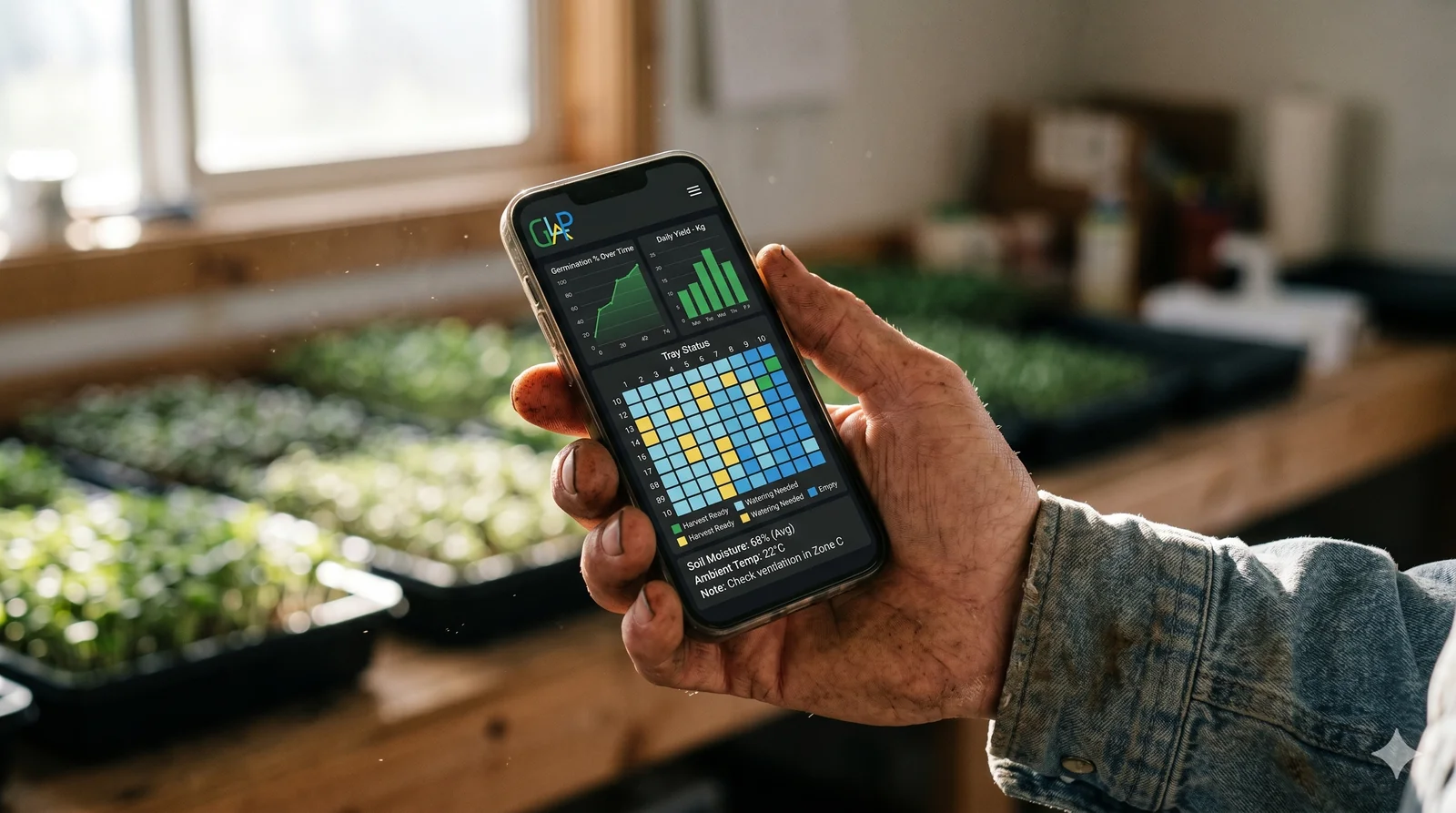
microGREEN FX is a family microgreens farm in Schwenksville, Pennsylvania, run by Sergio Markarian alongside his wife Celine and their three kids. The farm grows 27 varieties under a peat-free soil blend formulated in 2022, delivers across Montgomery County the same morning the trays are cut, and runs every operational decision through a piece of software the farm wrote itself. The software is called GLAP, short for Microgreens Grown Like A Pro. It runs on iOS, Android, and web. It is the operating system for the entire farm, and it is now offered as a subscription product to other microgreens growers.
The first time Sergio walked someone through it in person, the response was, "Oh, so it teaches you how to water." That comment is the reason this article exists.
What GLAP Actually Does 📱
GLAP is not a watering reminder. The watering schedule is one component on roughly the seventeenth screen. To describe GLAP fairly, here is the actual feature surface, top to bottom.
Lifecycle and Traceability 🔍
Plant lifecycle management runs the four canonical microgreens stages: weighted blackout, unweighted blackout, light growth, and harvest window.
Every tray on the farm carries a printed QR code. Scanning the QR code surfaces the tray's variety, seed lot, planting date, current stage, days to harvest, pH range for that variety, target daily light integral, and the staff member assigned to the tray. The traceability runs from seed bag to delivery van.
Environmental Monitoring 🌡️
Environmental monitoring runs through Bluetooth temperature and humidity sensors paired to the device. A separate light sensor module reads ambient lux and converts it to PPFD, which is the photon flux measurement that actually matters to plant growth. DLI targets are set per variety, and the calendar warns if a tray under that target is approaching its harvest window without enough accumulated light.
Watering and Cheat-Sheet Library 📚
Watering schedules are configured per variety, once or twice daily depending on what the cheat-sheet library says about the seed. The cheat-sheet library is preloaded with over 60 microgreens varieties, each with germination temperature, blackout days, light days, target pH, watering frequency, expected yield, and harvest method. The library is editable, so a grower with a unique variety adds it once and the rest of the system inherits the new entry.
Harvest Forecasting and Yield ML 📊
Harvest forecasting is done tray by tray. Given current stage, environmental data, and historical performance for that variety on that farm, GLAP predicts harvest yield in grams and harvest readiness in days. After two or three growing seasons, the prediction model trains on the farm's own data and improves. This is the machine-learned yield prediction layer, not a marketing label, an actual regression that gets more accurate the longer the farm runs the app.
Operations: Cleaning, Inventory, Routes, Teams 🚚
Cleaning queue automation tracks which trays are dirty, which are sanitized, which are dry and ready, and which are stacked for the next planting. Inventory management covers seeds, soil, and containers, with low-stock alerts. Client and delivery route management lets the farm assign harvested trays to delivery stops and print a route sheet. Team task assignment lets the farm assign work to specific staff and track completion. The calendar surfaces planting reminders, transition days from blackout to light, and harvest deadlines. Localization runs in 17 languages.
The whole thing runs on iOS, Android, and a web dashboard for desktop use. There is a tiered subscription, so a one-person operation pays differently than a farm with employees and routes. Browse the microGREEN FX shop to see the trays GLAP tracked from seed to delivery.
The architecture under the surface is worth one paragraph for anyone who cares about it. The mobile app is React Native with a custom native bridge for Bluetooth Low Energy sensor reads. The backend runs Postgres with row-level security per farm tenant, real-time subscriptions for live tray updates, and edge functions for the harvest-forecasting model. The web dashboard shares the same backend, so a grower can scan a tray on a phone and see the result on a desktop without a sync delay. The yield-prediction model retrains nightly on each farm's accumulated data, so the predictions get more useful the longer the farm runs the app.
None of that is bragging. It is the disclosure a buyer would expect from any ag-tech vendor. The unusual part is that it came out of a working farm, not a Series-A funded startup with a marketing budget.
⚙️ GLAP Feature Surface, At a Glance
iOS, Android, web. Subscription-tiered for solo growers up through multi-employee operations.
The Under-Recognition Pattern 🌍
Local agricultural directories in southeastern Pennsylvania often list dozens of farms in Montgomery County. microGREEN FX is missed by some of those directories despite being PA Preferred certified, despite running a public delivery route to every Montco zip code, despite having multiple wholesale accounts. There is no malice involved. The listings just default to who the editor already knew.
That is the under-recognition pattern. It is quiet. It is not anyone's fault on a given day. The cumulative effect across years is that a minority-owned farm building serious infrastructure can end up invisible in the very channels that exist to help buyers find local farms.
The same pattern shows up in conversations about ag-tech. Ask a procurement officer at a regional grocery chain to name three farm-software companies and the answers will be Silicon Valley names or land-grant university spinouts. A Pennsylvania farm shipping production code on three platforms with a real subscriber base does not register, because the mental category for "minority-owned small farm" does not include "writes its own software."
The fix is not a complaint. The fix is to describe what is actually there.
What does it cost a buyer when a real producer goes uncounted in the local-farm directory? It costs the buyer a vendor. The household searching "locally grown microgreens Montgomery County" gets a directory page with eight farms on it, none of which deliver. The wholesale buyer searching for a PA Preferred microgreens supplier gets a generic list with no contact details for the farm 18 minutes from their warehouse. Under-recognition is a procurement problem first. The minority-ownership angle is the reason the gap persists, but the consequences land on the buyer.
The "Just Teaches You to Water" Moment 💧
When Sergio opens GLAP for someone for the first time, the natural first screen is the calendar with watering reminders, because that is what most growers want first. The reduction to "oh, so it teaches you how to water" comes from that first screen. The listener pattern-matches to the simplest possible explanation, and the reduction sticks.
Pattern-matching is normal. The question is what gets pattern-matched. Picture the same demo run by an engineer in a hoodie at a startup incubator. The first screen would be described as "the daily-task surface, calendar-driven, with sensor-pull and machine-learned forecasting underneath." Same software. Different framing because of who is presenting.
The reduction to "teaches you how to water" is not unique to GLAP. It happens to a lot of small operators who do unexpected work. What happens when the operation behind your food is more sophisticated than the grocery store buying from it? It looks invisible, because invisibility is what the listener brought to the room.
The right way to handle the moment is not to argue. The right way is to keep walking. Open the next screen. Show the QR scan. Show the Bluetooth sensor pairing. Show the harvest forecast page with the trained yield model. By the third or fourth screen, the listener has already revised their first sentence in their head. No persuasion, just disclosure. The work speaks if the work is allowed to speak for the full demo.
Why a Minority Farm Building This Matters ⚖️
The ag-tech industry has a credibility problem with working farmers. Most platforms are built by people who never harvested under deadline. The UI assumes the user has time to enter data on a desktop in a quiet office. The data model assumes plot sizes that make sense in Iowa, not on a Schwenksville greenhouse floor. The pricing assumes venture-funded buyers, not bootstrapped farms.
GLAP exists because Sergio kept hitting walls in those platforms during actual harvest mornings. Every feature in GLAP traces back to a problem that showed up on the floor. The QR codes exist because handwritten labels rubbed off in the cooler. The DLI targets exist because variety yield kept varying with overcast weeks. The cleaning queue exists because tray rotation got missed during a busy delivery week. None of it was theoretical.
The fact that the farm building it is minority-owned matters for one reason. The dominant narrative about who builds infrastructure leaves minority-owned farms in the consumer category, never in the producer-of-tools category. GLAP exists in the producer-of-tools category. That is not a slogan. It is a working iOS, Android, and web product running in production at microGREEN FX and at other operations.
microGREEN FX is the only 100% minority-owned and minority-run microgreens farm operating in Montgomery County. The full piece on that designation lives here. The combination of being the only minority-owned farm of its kind in the region and being the farm that wrote its own ag-tech is not a coincidence. It is the same story.
What Buyers Should Look For 🛒
If you are buying microgreens for a household, a restaurant, or a grocery store, the relevant question is whether the operation behind the trays runs tight enough to deliver consistently. Software is one signal. Not the only signal, but a real one. A farm that scans every tray, schedules every transition, and forecasts every harvest is a farm that knows where its product is at every minute of its lifecycle.
Cut-to-cooler time at microGREEN FX runs under 90 seconds per tray. Cut-to-door runs under 8 hours for every Montco subscriber. The freshness math is broken down here. The reason those numbers hold is that GLAP does not lose track of trays. The same software that lets the farm forecast yield also lets it forecast its own delivery windows.
For wholesale buyers, the lift goes further. Per-tray QR codes mean traceability that satisfies most retailer audit requirements out of the box. Variety-level pH and DLI tracking means the trays a buyer receives in week 12 match the trays from week 1. Inventory and route data means microGREEN FX can scale up or down on a buyer's order without losing reliability.
The other question worth asking is whether the farm has a plan beyond the next harvest. A farm that wrote its own software has, by definition, thought past next week. The roadmap exists. The data is collected. The growing seasons compound on top of each other instead of starting from zero each spring. That kind of compounding is what wholesale buyers actually pay for when they sign a multi-quarter contract. The trays are the deliverable. The reliability behind the trays is the product.
The Family Behind the Code 🤝
Sergio writes the code. Celine runs operations. The three kids help on harvest mornings the way kids on a working farm always have, hauling trays, taping route labels, learning the names of the varieties before they learn the multiplication tables.
That detail is in the article for one reason. Family farms are not a marketing category at microGREEN FX. They are the actual structure of the operation. The same kitchen table that hosts dinner hosts the iteration meetings on the next GLAP feature. The same greenhouse that runs the morning harvest runs the QA pass on a new sensor integration. The boundary between "the farm" and "the company that built GLAP" does not exist, because both are the same household.
Buyers who care about supporting family-run agriculture sometimes ask whether scale and family-run can coexist. The answer at microGREEN FX is that they have to. The software exists because the family could not afford to lose harvest hours to operational drift. The route runs tight because every tray that goes out the wrong door is dinner-table conversation that night. There is no remote operations team to absorb the friction.
What Comes Next 🚜
GLAP keeps growing. The yield-prediction model gets better as more growing seasons feed into it. The cheat-sheet library keeps adding varieties. The localization expanded from English to seventeen languages because growers in Latin America, the Middle East, and parts of Africa started subscribing. Some of those growers found GLAP because the existing ag-tech tools did not speak their language. That problem solved itself the moment a farm in Schwenksville decided to ship localization.
microGREEN FX keeps growing too. Schwenksville delivery remains the home base, with Harleysville and the rest of Montgomery County on the same Tuesday and Friday route. Every tray on every doorstep was scheduled, watered, harvested, and routed inside GLAP.
The article opened with a question. Have you ever asked the farmer who supplies your microgreens what their software stack looks like? Now you have at least one answer. The farm in Schwenksville built it. The farm runs on it. Other farms run on it. The next time someone reduces a small farm to clipboards and good intentions, the question to ask is whether the listener is describing the farm or describing the assumption they walked in with.
Frequently Asked Questions 🤔
What is the GLAP app and who built it? +
What does GLAP actually do beyond watering reminders? +
Why does it matter that GLAP came out of a minority-owned farm and not a tech company? +
Can other microgreens farms use GLAP, or is it internal only? +
Does buying microgreens from microGREEN FX have anything to do with GLAP? +
How can I see GLAP or order microgreens from microGREEN FX? +
Related Reading 📚
The Only 100% Minority-Owned Microgreens Farm in Montgomery County, PA
The designation, the work, and what it means for buyers.
🌿Freshest Microgreens in Montgomery County, PA
Same-day-harvest delivery across every Montco town.
📍Schwenksville Delivery
Home-base zip 19473, every Tuesday and Friday.
🚚Harleysville Delivery
15 minutes from the farm, on the regular route.