📍 Quick Answer
Most home microgreen setups fail by month 3 because of mold, water-source issues, and substrate inconsistency, not because the grower made a mistake. The starter kits do not warn about chlorinated water, do not teach mold-vs-root-hair identification, and ship a single substrate type that may be wrong for the grower's environment. A working-farm class fixes the gaps. microGREEN FX runs classes in Schwenksville, PA that specifically address what the kits and YouTube videos skip.
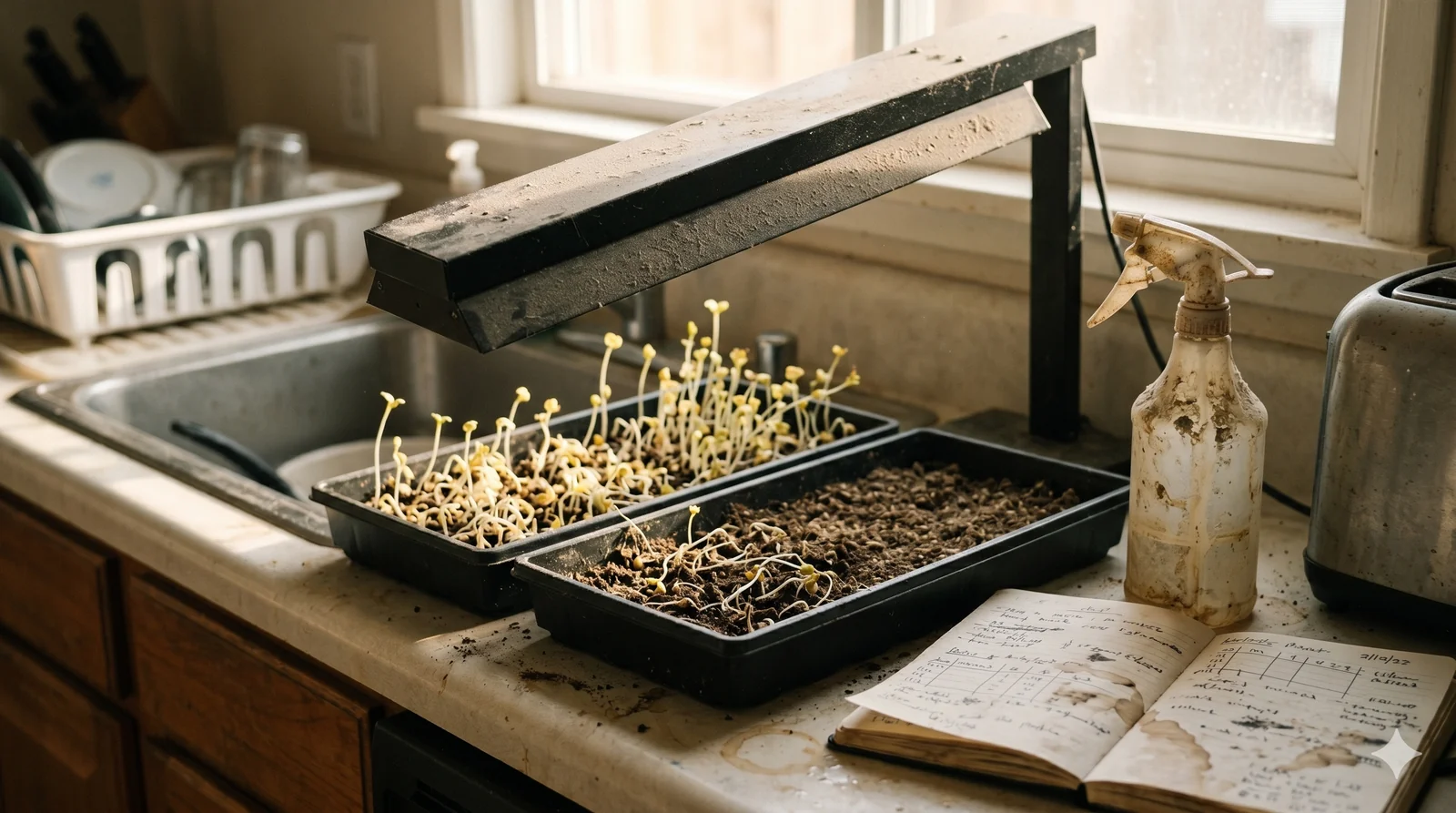
You bought the kit, ordered the seeds, set up the shelf in the kitchen. Tray 1 was a triumph. Tray 2 was fine. Tray 3 had a problem. 📉
Maybe it was white fuzzy stuff that you were not sure was mold or root hair. Maybe the germination was uneven. Maybe the leaves came in yellow instead of green. Tray 4 you tried again and it failed. Tray 5 you never planted. The shelf is in the basement now.
Almost every home microgreen grower has this exact arc. It is not because microgreens are hard. It is because the starter kit and the YouTube video left out the variables that determine whether a setup is repeatable.
The Three Things That Break Home Setups 💥
- Water source. Chlorinated municipal water disrupts the seed coat enzymes for some varieties (especially basil, sunflower, beet). The first 2 trays often work fine because the seeds are robust. By tray 3 you are using a different lot of seed, the water has slightly more chlorine that day, and germination drops to 60 percent.
- Mold misidentification. Beginners cannot reliably tell white root hair from white mold. They throw out healthy trays thinking they are moldy. They keep moldy trays thinking the white fuzz is normal. Either way, confidence drops and the next tray gets planted with anxiety.
- Substrate inconsistency. Coconut coir varies by brand and batch. Peat is denser than coir and holds water differently. The starter kit ships one substrate. When you reorder, you get a different brand, the trays behave differently, and you blame yourself.
Why YouTube and Starter Kits Will Not Solve It 🎬
The starter kit makes money on the kit, not on your repeat success. The YouTube channel makes money on views, not on whether you complete tray 30. Neither has an incentive to teach you the troubleshooting that protects month 3.
A working-farm class has a different incentive. We grow hundreds of trays a week. We have run into every failure mode and figured out the prevention because our livelihood depends on it. The class compresses years of failure data into a few hours.
What the microGREEN FX Class Specifically Addresses 🌾
- Mold prevention protocol. Specific actions, in order, that drop your mold rate from 1-in-3 trays to 1-in-30. Includes water treatment, airflow setup, and seeding density.
- Mold-vs-root-hair identification. We open a 10-day-old root mat in front of you so you see the difference with your own eyes. After this, you stop guessing.
- Water source decision tree. Based on your home water (we will ask you), what to filter, what to skip, what to buy.
- Substrate choice for your environment. Coconut coir vs MicroThrive Soil vs hemp mat. We compare them on the bench in front of you. You leave knowing what to use.
- 30 days of text-message support. When tray 4 has a weird issue at home, you text us a photo. We tell you what it is. Most "failures" are easy fixes once you have someone to ask.
A Few Calibrating Questions 🤔
- How many trays did you plant before your home setup stalled?
- When the failure happened, did you know what went wrong, or did you guess?
- If you could text someone a photo of a problem tray and get an answer within a few hours, would your home setup still be running?
- Are you trying to grow microgreens for your family's own eating, to sell at a market, or to teach a kid? The class focus is slightly different for each.
Sign Up for the Class That Saves Month 3 🌿
Adult class, 3 hours, on the working farm. Includes a planted tray, supplies for 5 more, written troubleshooting guide, and 30 days of text-message support. Most graduates are still growing 6 months later.