⚠️ A Quick Note
We are a family-run microgreens farm in Schwenksville, PA - not a medical clinic. The research and nutrient data below are presented for general educational purposes. Microgreens are food, not medicine, and they should complement (not replace) advice from your doctor, registered dietitian, or other licensed healthcare provider. Always consult a qualified professional before making dietary changes to address a specific health condition - especially if you are pregnant, breastfeeding, taking medications, or managing a chronic illness.
📍 Quick Answer
Broccoli microgreens are the most-studied microgreen variety for blood sugar research. A 2017 randomized controlled trial published in International Journal of Food Sciences and Nutrition by Bahadoran and colleagues found that broccoli sprout consumption (a close relative of broccoli microgreens) significantly reduced fasting blood glucose and insulin resistance markers in patients with type 2 diabetes. The active compound studied is sulforaphane. Microgreens contain dramatically more sulforaphane per gram than mature broccoli. This is not a substitute for diabetes medication or a doctor-supervised treatment plan.
When someone with type 2 diabetes asks "are there foods that can help with my blood sugar," the honest answer is complicated. There is no "diabetes superfood" that replaces medication, exercise, or weight management. There are foods that, in repeatable peer-reviewed studies, show measurable effects on insulin sensitivity and fasting glucose. Broccoli microgreens are one of those foods. 🥦
The compound doing most of the work is called sulforaphane. It is concentrated in cruciferous vegetables - broccoli, kale, cabbage, brussels sprouts. The breakthrough research came out of Johns Hopkins under the late Dr. Paul Talalay, who established that broccoli sprouts contain dramatically more sulforaphane than mature broccoli. Microgreens, harvested at the cotyledon stage, sit in a similar concentration window.
Here is the research-honest version of what we know.
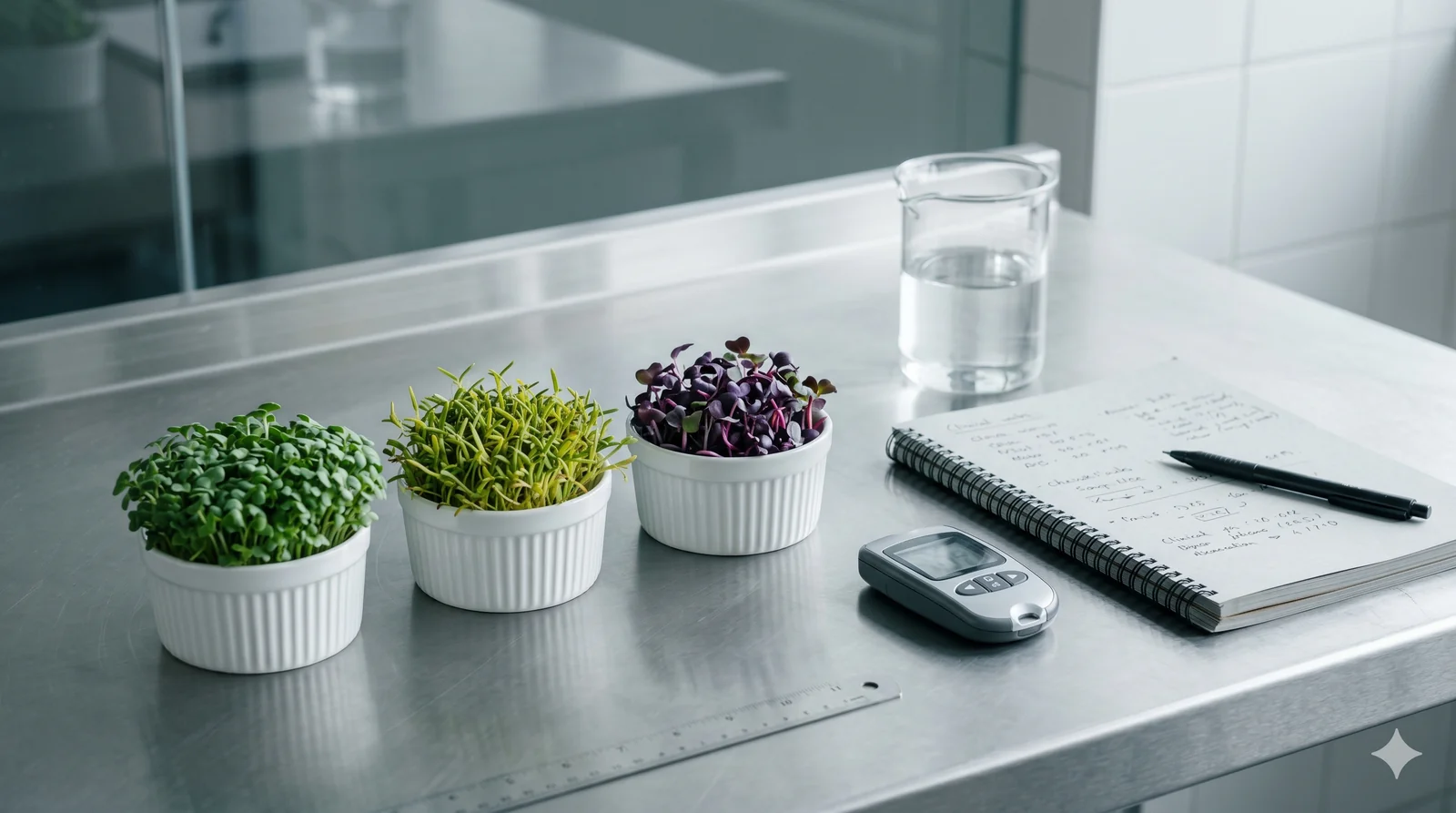
Which Microgreens Look Most Promising for Diabetes 🌱
Beyond broccoli, the cruciferous family includes several other microgreens that share the same sulforaphane biology: kale, cabbage, mustard, radish, kohlrabi, and pak choi. Studies have been run primarily on broccoli but the family-level evidence supports a varied cruciferous intake.
- Broccoli - the most-studied. Up to 100x sulforaphane vs mature broccoli (Sun et al., 2013).
- Kale - cruciferous family, additional polyphenols.
- Red Cabbage - anthocyanins plus glucosinolates.
- Mustard - high glucosinolate content.
- Radish - cruciferous, peppery sulforaphane delivery.
How to Eat Them for Maximum Sulforaphane 🥗
Sulforaphane is generated when myrosinase enzyme contacts glucoraphanin (the precursor) - typically when the plant is chopped or chewed. Cooking destroys myrosinase. Eating microgreens raw preserves the enzymatic conversion.
A common evidence-aligned routine: a small handful (~15-30g, roughly 1 oz) of cruciferous microgreens daily, eaten raw on salads, in smoothies, or as a topping on warm dishes added at the end so heat does not deactivate the enzymes.
There are no dosing studies on microgreens specifically (most studies use broccoli sprout extract or sprouts), so the practical advice is "include them daily, raw, as part of a doctor-supervised plan" - not "they cure diabetes."
What Peer-Reviewed Studies Actually Show 📚
A 2017 randomized double-blind placebo-controlled trial led by Axelrod and Bahadoran tested broccoli sprout extract on 81 patients with type 2 diabetes. After 12 weeks, the treatment group showed significantly lower fasting plasma glucose and improved insulin resistance compared to placebo (International Journal of Food Sciences and Nutrition).
A 2017 study published in Science Translational Medicine by Axelsson and colleagues tested broccoli sprout extract specifically targeting hepatic glucose production. The treatment lowered fasting glucose levels in obese diabetic patients with measurable HbA1c improvements over the trial period.
A 2018 review in Antioxidants by Bahadoran and Mirmiran concluded that cruciferous vegetable consumption is "consistently associated with reduced risk of type 2 diabetes" across multiple cohort studies.
The mechanism: sulforaphane activates the Nrf2 pathway, which upregulates phase 2 detoxification enzymes and improves cellular response to oxidative stress - both factors implicated in insulin resistance.
📚 Cited Research
- Bahadoran Z, et al. (2017). Effect of broccoli sprouts on insulin resistance in type 2 diabetic patients: a randomized double-blind clinical trial. International Journal of Food Sciences and Nutrition.
- Axelsson AS, et al. (2017). Sulforaphane reduces hepatic glucose production and improves glucose control in patients with type 2 diabetes. Science Translational Medicine.
- Sun J, et al. (2013). Profiling polyphenols in five Brassica species microgreens. Journal of Agricultural and Food Chemistry.
- Bahadoran Z, Mirmiran P. (2018). Cruciferous vegetables and risk of type 2 diabetes. Antioxidants.
- Talalay P, Fahey JW. (2001). Phytochemicals from cruciferous plants protect against cancer by modulating carcinogen metabolism. Journal of Nutrition.
Get Fresh Cruciferous Microgreens 🌿
Same-day-harvest broccoli, kale, mustard, red cabbage, and radish microgreens delivered free across SE Pennsylvania. PA Preferred certified family farm in Schwenksville.