⚠️ A Quick Note
We are a family-run microgreens farm in Schwenksville, PA, not a medical clinic. The research cited below is presented for general educational purposes. Microgreens are food, not medicine, and they should complement (not replace) advice from your doctor, registered dietitian, or other licensed healthcare provider. Always consult a qualified professional before making dietary changes to address a specific health condition.
📍 Quick Answer
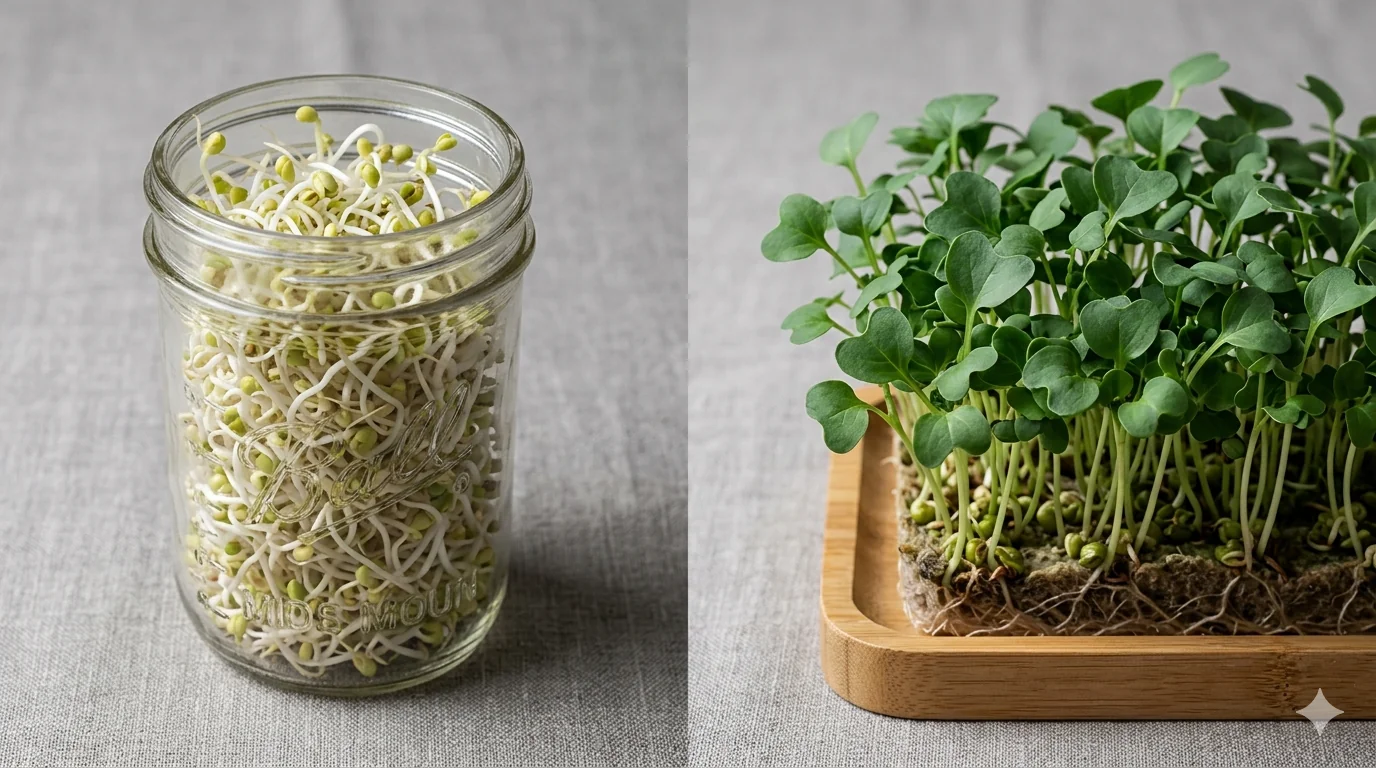
Both broccoli sprouts (3-7 days) and broccoli microgreens (8-15 days) deliver dramatically higher sulforaphane than mature broccoli, but they differ on safety, texture, and use case. Sprouts are eaten whole (root, seed coat, and shoot) and grown in constant moisture, which carries a higher listeria/salmonella risk per CDC guidance. Microgreens are harvested above the soil line, grown in well-drained media, and have a much lower foodborne illness profile. For most home eaters, microgreens are the safer same-bioactivity choice.
When the Johns Hopkins Talalay lab published the 1997 broccoli sprout sulforaphane research, the world's first commercial broccoli sprout brand (BroccoSprouts, from Brassica Protection Products) launched within months. Microgreens came later - the cultivation method, terminology, and commercial market only really crystallized in the early 2010s. 🌱
But here is the thing most consumers do not realize: sprouts and microgreens are functionally similar from a sulforaphane perspective. Both are harvested at very young plant stages where glucoraphanin (the sulforaphane precursor) sits at peak concentration. The differences between them have nothing to do with bioactive content, they are about safety, ease of use, and storage.
Here is the side-by-side that actually matters.
The Side-By-Side Comparison 📊
Here is what changes between sprouts and microgreens for the same plant family:
Safety: Why Microgreens Have a Lower Risk Profile 🛡️
Sprouts are grown in constant high humidity at warm temperatures, exactly the conditions that allow listeria, salmonella, and E. coli to grow if any contamination is present in the seed. The CDC has tracked at least 30 documented sprout-associated outbreaks in the US since 1996.
Microgreens are grown in soil or soilless media that drains. The mature plant grows above the surface. We harvest by cutting the stem above the soil line, meaning the part you eat has never touched the growing medium. Same-day harvest from a small farm with controlled conditions has an even lower risk profile than commodity microgreens.
Pregnant people, elderly, immunocompromised, and young children are advised by FDA/CDC to avoid raw sprouts entirely. Microgreens carry the same general "wash all raw produce" guidance as any other leafy green but are not in the elevated-risk category.
Sulforaphane Content: Functionally Equivalent 🔬
Per gram of fresh weight, broccoli sprouts and broccoli microgreens deliver similar glucoraphanin concentrations. Both are harvested at young plant stages where the bioactive compound peaks. The 1997 Talalay paper used 3-day sprouts; subsequent microgreen studies extended findings to 8-15 day microgreens.
Both forms require myrosinase activation (raw consumption + chewing) to convert glucoraphanin into active sulforaphane. Eating either cooked dramatically reduces bioavailable sulforaphane.
For commercial supply: microgreens are easier for restaurants and home cooks to handle. Sprouts have to be used within days; microgreens last 3-6 weeks in proper refrigeration when same-day-harvested. That difference is huge for actual real-world consumption.
What Research Says About Sprouts vs Microgreens 📚
The Talalay lab's 1997 paper established 3-day broccoli sprouts as having 20-100x the glucoraphanin of mature broccoli. Subsequent research (Sun et al., 2013) extended these findings to 8-12 day microgreens, showing similar concentrations in the same plant family.
A 2017 review in Critical Reviews in Food Science and Nutrition compared sprout vs microgreen growing systems. Sprouts are grown in constant moisture (jars, mats, hydroponic chambers) and consumed whole including root and seed coat. Microgreens are grown in soil or soilless media, harvested by cutting above the soil line, and consumed without root.
The CDC tracks foodborne illness outbreaks. Raw sprouts have been associated with at least 30 documented outbreaks since 1996, primarily salmonella and E. coli, according to CDC data. The constant warm-moist environment that sprouts need is also ideal for bacterial growth. The FDA classifies raw sprouts as a higher-risk food category.
Microgreens have a meaningfully lower outbreak history because they are grown in less moist conditions and harvested above the contamination zone. Same-day-harvest microgreens from a small clean farm have an even lower risk profile than commodity microgreens.
📚 Cited Research
- Fahey JW, Zhang Y, Talalay P. (1997). Broccoli sprouts: an exceptionally rich source of inducers of enzymes that protect against chemical carcinogens. PNAS.
- Sun J, et al. (2013). Profiling polyphenols in five Brassica species microgreens. Journal of Agricultural and Food Chemistry.
- CDC. Foodborne Outbreak Surveillance. Sprout-associated outbreak history (1996-present).
- Mir SA, et al. (2017). Microgreens: Production, shelf life, and bioactive components. Critical Reviews in Food Science and Nutrition.
- Vermeulen M, et al. (2008). Bioavailability of sulforaphane from cooked vs raw broccoli. JAFC.
Get the Safer Same-Bioactivity Option 🌿
Same-day-harvest broccoli microgreens delivered free across SE Pennsylvania. Lower foodborne risk than sprouts. Same sulforaphane potential. 3-6 week shelf life vs 3-7 days for sprouts.