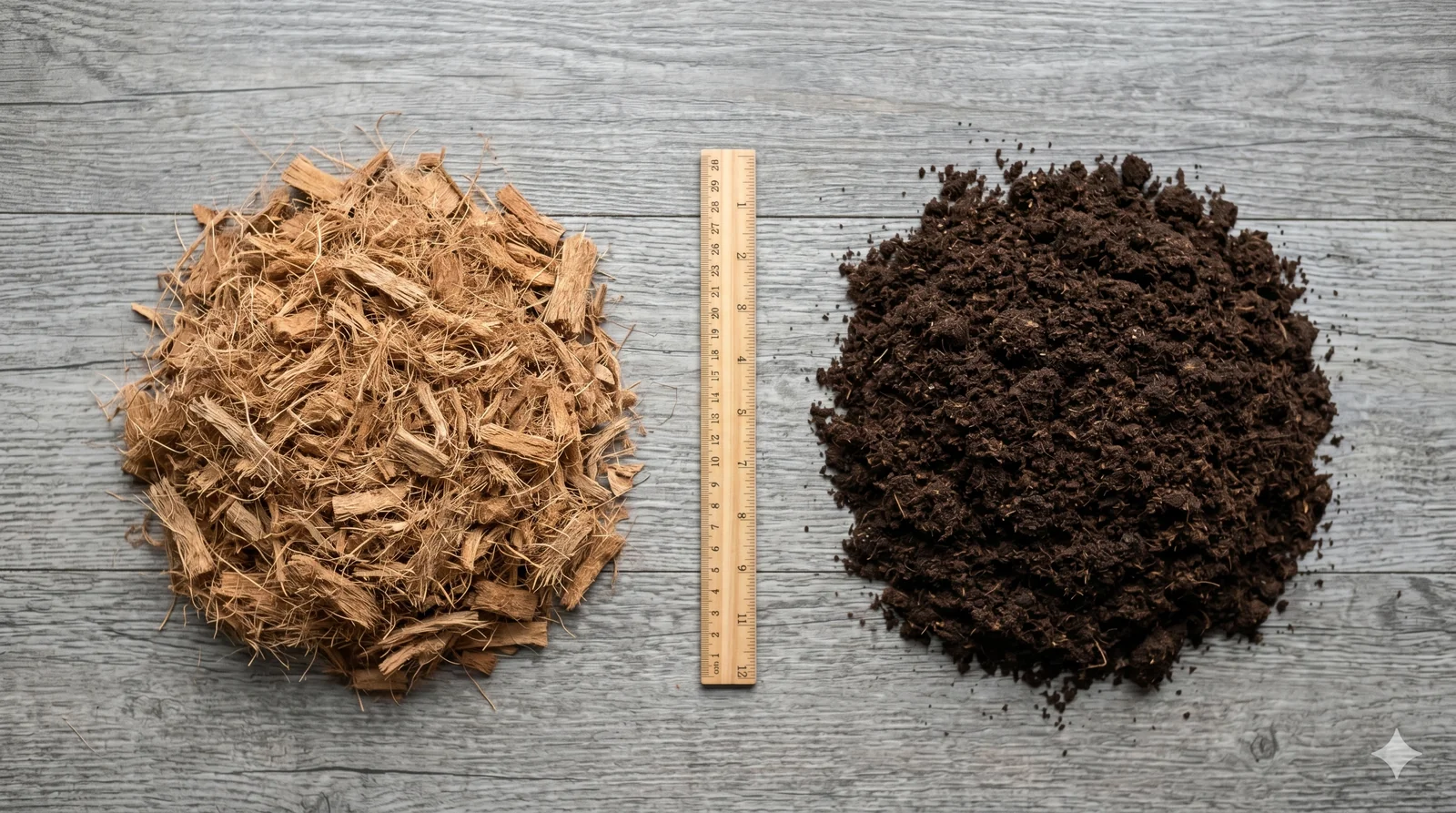
📍 Quick Answer
Coconut coir is dramatically more sustainable than peat moss - it is a renewable byproduct of the global coconut industry rather than a 1,000-year-old non-renewable resource. Coir holds water similarly to peat with a friendlier pH (6-7 vs peat's acidic 4.5). Downsides: shipped from Sri Lanka or India (real freight footprint) and naturally low in nutrients (needs fertility partner). microGREEN FX uses neither, our MicroThrive Soil is a custom peat-free, coir-light blend optimized specifically for microgreens.
When the global gardening community started waking up to peat extraction's environmental cost in the early 2000s, coconut coir became the obvious replacement. It was renewable. It was a byproduct of an industry that already existed. It performed similarly in pots and beds. 🥥
Today, coir is the dominant peat alternative in commercial horticulture, sold by every major substrate company, used by serious home growers, and forming the base of countless "peat-free" potting mixes.
But coir has its own footprint. The freight from Sri Lanka or India is real. The processing requires lots of fresh water. And it is naturally low in nutrients, which means commercial mixes need supplementation. So how does it actually compare to peat?
When Coir Wins, When It Doesn't 🌍
- Coir wins on renewability. Annual coconut harvest produces effectively unlimited supply at a renewable scale. Peat is permanent damage at human timescales.
- Coir wins on pH. Coir is pH 6-7 (neutral-ish). Peat is pH 4.5 (acidic). Most plants prefer the coir range without adjustment.
- Peat wins on local sourcing if you live near a Canadian peat extraction region. Coir from Sri Lanka has more freight miles. But the freight footprint is dwarfed by peat's extraction footprint.
- Coir is poor in nutrients on its own. Unlike compost-rich blends, pure coir provides almost no nitrogen, phosphorus, or potassium. Commercial mixes pair it with vermicompost, perlite, or fertilizer.
- Coir can hold sodium from coastal processing if not properly washed. Better-quality coir is buffered (calcium-soaked) to displace sodium. Cheap coir can stunt sensitive plants.
Why microGREEN FX Uses Neither (and What We Use Instead) 🌱
We grow in our own proprietary MicroThrive Soil™ - a custom peat-free blend optimized specifically for microgreens, not for general horticulture. The recipe includes vermicompost (for microbial life and nutrients), wood fiber (for structure), and a small portion of coir (for water retention) - but none of those ingredients dominate the way peat dominates a typical commercial mix.
We chose this approach because commodity peat-based mixes (PRO-MIX, Sunshine Mix, Berger BM-2) make the soil cost-effective for industrial growers but lock the entire industry into an unsustainable supply chain. By building our own substrate, we control the ingredients, the sourcing, and the environmental impact end-to-end.
Our customers do not have to take our word on it. The microgreen quality, shelf life, and flavor speak for themselves: 3-6 weeks of fridge shelf life vs 3-10 days for distributor-supplied microgreens grown in commodity peat mixes.
What Sustainability Research Actually Documents 📚
Peat formation rate: 0.5-1 mm per year. A foot of peat takes ~300 years. A meter takes ~1,000 years. (IUCN UK Peatland Programme.)
Coir formation rate: coconuts mature in 12 months. Husks (the source of coir) are a byproduct of an existing industry that produces ~62 million tons of coconuts annually globally. Coir is essentially recycled waste.
Carbon emissions from drained peatlands: ~1.9 gigatonnes CO2/yr globally. That is 5% of all human-caused emissions from just 0.3% of land area. (IUCN Global Peatland Assessment, 2022.)
Coir freight footprint: shipping 1 ton of coir from Sri Lanka to the US Northeast emits roughly 0.04 tonnes of CO2 (per IMO maritime emissions data). Compared to peat's 1.9 GT/yr from drained source landscapes, the coir freight is dramatically smaller per unit.
Performance comparison: multiple horticulture trials (Cornell, Penn State Extension, Royal Horticultural Society) show coir performs comparably to peat for water retention, with better pH and similar physical properties.
📚 Cited Research
- IUCN UK Peatland Programme. Peat Carbon and Climate factsheets.
- Global Peatlands Assessment. (2022). UNEP Global Peatlands Initiative.
- Royal Horticultural Society. Peat-Free Compost Trials, ongoing.
- Cornell Cooperative Extension. Soilless Growing Media research.
- Wetlands International. Peat extraction and horticulture briefs.
Get Microgreens Grown Without Peat 🌿
Same-day-harvest microgreens grown in our peat-free MicroThrive Soil. Free delivery across SE Pennsylvania. PA Preferred certified family farm.