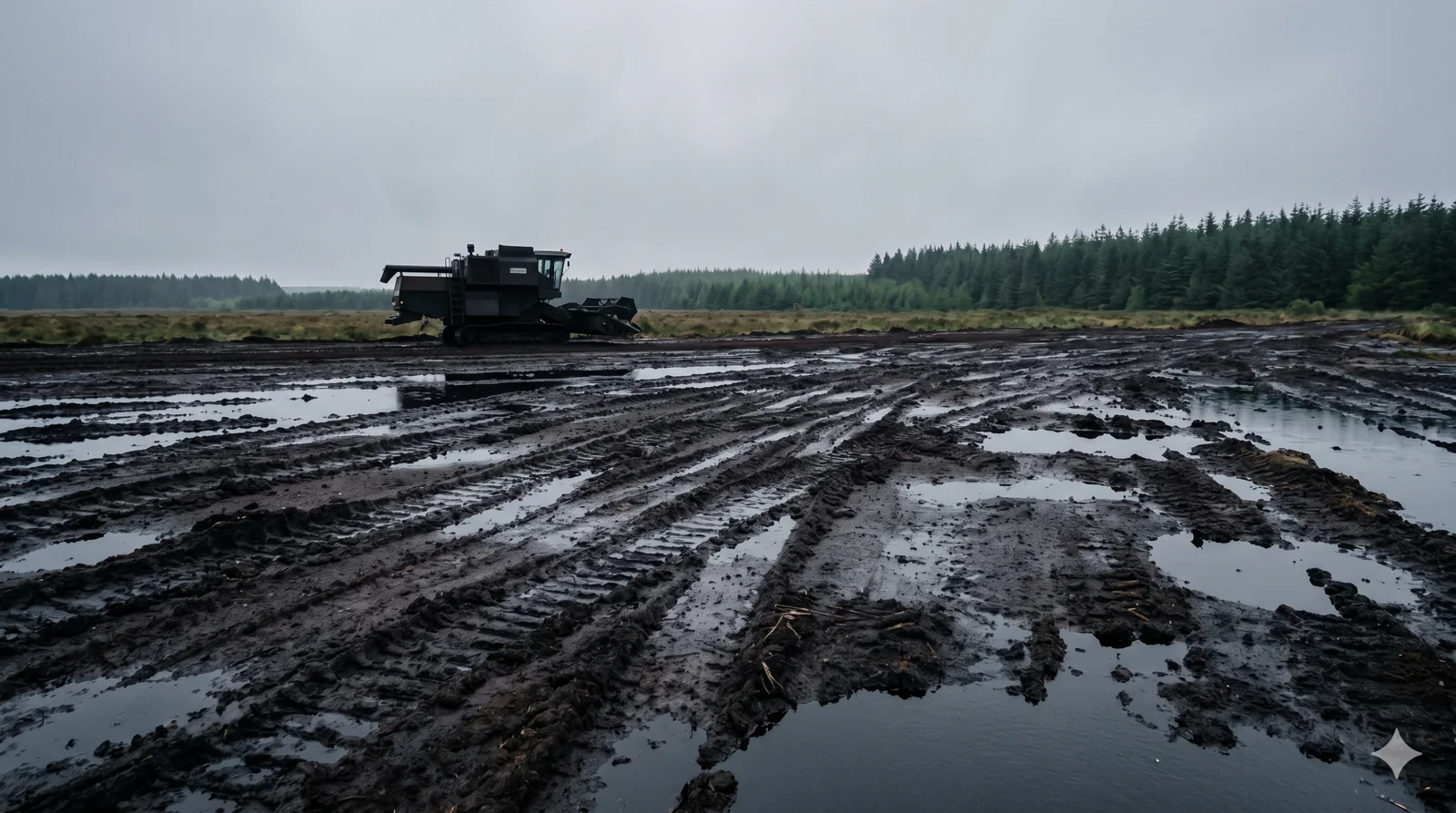
Walk into nearly any microgreen farm in North America and you will find the same bag stacked on the same pallet: a peat-based growing mix, usually PRO-MIX HP or Sunshine Mix or Berger BM-2. They are 65 to 95 percent Canadian sphagnum peat moss. They are the industry default. And almost nobody talks about what it actually takes to fill those bags. 🌍
We do not use peat. We never have. Once you understand what peat actually is, where it comes from, and what is being destroyed to extract it, the case for peat-free microgreens stops being a marketing angle and starts being an ethical baseline. This is the post we wish more farms would write about themselves.
What Peat Moss Actually Is 🧬
Peat is the partially decomposed remains of sphagnum moss and other wetland plants, accumulated layer by layer in waterlogged bogs over thousands of years. Because the water is acidic and oxygen-poor, the plant matter does not break down the way leaves do in a forest floor. It just stacks up - one millimeter at a time.
A single foot of peat takes roughly 300 years to form. A meter takes around 1,000 years (IUCN UK Peatland Programme). When a peat company harvests an acre of bog, they are pulling out a deposit that started forming when the Roman Empire still controlled Britain. Once it is gone, it is gone on any timescale that matters to a human being. There is no replanting your way out of this.
⏳ Peat By the Numbers
- 1 foot of peat: ~300 years to form
- 1 meter of peat: ~1,000 years to form
- Land coverage: 3% of Earth's surface
- Carbon stored: ~30% of all global soil carbon
- Annual CO2 emissions from drained peat: ~1.9 gigatonnes (5% of all human emissions, from 0.3% of land)
- Global peatland destroyed yearly: ~500,000 hectares (UNEP, 2024)
Peat Bogs Are the Largest Carbon Stores on Land 🔥
Peatlands cover only about 3 percent of the planet's land surface but store roughly 30 percent of all soil carbon - more carbon than every forest on Earth combined, by a factor of about two (UNEP Global Peatlands Assessment, 2022). For climate purposes, an intact bog is one of the most efficient pieces of geography on the planet.
When a bog is drained for peat extraction, that ancient carbon meets oxygen for the first time in millennia and immediately starts oxidizing into CO2. Drained peatlands worldwide currently release approximately 1.9 gigatonnes of CO2 per year - about 5 percent of all human-caused greenhouse gas emissions (IUCN). And that number comes from just 0.3 percent of the world's land area. Peatlands are, pound for pound, the highest-impact carbon emitters on the planet when we damage them.
Tropical peat is even worse. Drained peat in Indonesia for oil palm releases up to 55 tonnes of CO2 per hectare per year (World Resources Institute). The 2015 Indonesian peat fires emitted 1.62 billion tonnes of CO2 in a single fire season - more than the entire annual output of the United States economy on peak days. That single event released roughly the carbon that 22 years of natural peat accumulation had stored.
Peat Bogs Filter the World's Drinking Water 💧
Peatlands are not just carbon storage. They are massive natural water filters and reservoirs. Approximately 70 percent of UK drinking water comes from catchments dominated by peatland habitat (IUCN UK Peatland Programme). A 2018 paper in Nature Sustainability by Xu and colleagues found that 85 percent of all peatland-derived drinking water on the planet is consumed in the UK and Republic of Ireland alone, supplying an estimated 28.3 million people - about 43 percent of the UK population.
When peat bogs are drained for the horticulture industry, the water that runs off becomes brown with dissolved organic carbon, requiring expensive treatment downstream. Extracting peat for someone's garden compost is a transaction in which the cost is paid by everyone who turns on a tap.
The Animals Losing Their Homes 🐦
Peat bogs are one of the rarest, most specialized ecosystems on Earth, and a significant share of the species that live in them live nowhere else. When a bog is drained, those species do not relocate. They die out. Many of them are already on the brink.
- The curlew (Numenius arquata): Britain's largest wading bird. UK Red List, IUCN globally Near Threatened. Breeds almost exclusively on wet peatlands and moorland. Population has crashed by more than 60 percent since the 1980s.
- The hen harrier (Circus cyaneus): One of the UK's most endangered breeding raptors. Nests on the ground in deep heather and bog vegetation - habitat that simply does not exist after extraction.
- The golden plover, dunlin, and snipe: Iconic moorland breeders, all in significant decline. Dunlin breeding density rises exponentially with the number of bog pools per square kilometer (NatureScot).
- The large heath butterfly (Coenonympha tullia): Listed as Endangered in the UK. Its range has contracted by 58 percent between 1976 and 2014 (Butterfly Conservation). It depends entirely on the cottongrass that grows in undisturbed bogs.
- The bog bush cricket and raft spider: Specialist invertebrates that need standing bog water. They vanish when bogs are drained.
- Sphagnum moss itself: The bog-builder. There are around 30 native UK species and over 300 globally. Sphagnum holds 20 to 30 times its dry weight in water. Without it, there is no peat, no carbon storage, no clean water, no curlew nest.
- Sundew, bog rosemary, bog asphodel, common cottongrass: Specialist plants found nowhere else.
- Water voles and otters: Water voles are now Britain's most rapidly declining mammal. Their wet, slow-moving stream and bog habitat is being engineered out of existence.
When you buy a bag of peat-based potting mix, this is the cost. Not in some abstract sense. In actual nesting curlews, in butterfly populations that will not recover in our lifetime, in carbon emissions you cannot offset by taking a tote bag to the grocery store.
The Microgreen Industry's Quiet Problem 🌱
Walk into any commercial microgreen operation in the United States or Canada and you will find the same handful of names. PRO-MIX HP, PRO-MIX BX, Sunshine Mix #1 and #4, Berger BM-2, Fafard 3B. All peat-based. All sourced from drained Canadian, Irish, or northern European bogs. PRO-MIX BX is roughly 75 to 85 percent peat. PRO-MIX HP is 65 to 75 percent. PRO-MIX MPX runs 85 to 95 percent.
The microgreen boom of the last decade has driven a real, measurable spike in horticultural peat demand. The industry's standard answer is that the bogs are "responsibly managed" through programs like Veriflora certification. But responsible extraction of a non-renewable resource that takes a thousand years to regenerate is still extraction. There is no version of "responsible" that makes the bog grow back faster than it can be harvested. Sun Gro itself acknowledges that Canadian peat is harvested far faster than any individual bog regenerates - they argue that across all of Canada the total peat coverage is so vast it does not matter. That is a defensible accounting argument and a terrible ecological one.
The Wildlife Trusts estimate that horticulture in the UK still consumes 760,000 cubic meters of peat per year. Most of it goes into bagged compost and commercial growing mixes - the same kind of mix in your local microgreen farmer's grow room.
Governments Are Banning Peat - For Good Reason 🏛️
This is not a fringe environmental position. Multiple governments have moved to ban peat outright after decades of voluntary phase-outs failed.
- United Kingdom: DEFRA announced in 2022 that retail peat sales to amateur gardeners would end. Implementation is being legislated for 2026, with a full professional sector ban by 2030. The UK government's own statement: "Peatlands are the UK's largest carbon store."
- Republic of Ireland: Bord na Mona, once the largest industrial peat producer in Europe, ended all peat harvesting on its lands in January 2021. Peat briquette production ended in 2024. The European Commission has referred Ireland to the European Court of Justice for failing to protect over 100 Special Areas of Conservation peat bogs.
- European Union: Wetlands International has flagged horticultural peat extraction as one of Europe's top peatland threats. Multiple member states are pursuing tighter restrictions.
What Conservation Groups Are Saying 📢
The list of organizations actively campaigning to end horticultural peat use reads like a roster of the most credible environmental institutions in the English-speaking world.
🛡️ Who Is Fighting Peat Extraction
- RSPB (Royal Society for the Protection of Birds) - Runs the #ForPeatsSake campaign. Adrian Thomas, RSPB wildlife gardening expert: "I've gardened peat-free for over 20 years... the quality of peat-free composts has really improved."
- Plantlife - "Keep Peat in the Ground & Out of Our Gardens" campaign. Demands a legal ban because "repeated voluntary targets have been consistently missed."
- The Wildlife Trusts - "Ban the Sale of Peat" campaign. Called the UK government's delay on legislation "bitterly disappointing."
- Friends of the Earth UK - Has campaigned on peat since 1996. Notes that progress has moved "at a snail's pace."
- Greenpeace - Active campaigning on Indonesian peatland destruction for palm oil and pulp paper.
- IUCN UK Peatland Programme - Publishes the authoritative "Peat-Free Horticulture - Demonstrating Success" case studies.
- Wetlands International - Promotes paludiculture (wet farming of sphagnum) as a substitute for peat extraction.
- Peat-Free Partnership - Coalition of RHS, Wildlife Trusts, Plantlife, RSPB, B&Q, Co-op, and over 100 signatories including Chris Packham, sent a letter to the UK Prime Minister demanding legislative action.
- #PeatFreeApril - Annual grassroots social media campaign encouraging gardeners to make the switch.
Monty Don, the host of BBC's Gardeners' World and one of the most respected gardening voices in the world, has put it bluntly: "The extraction of peat for horticultural use is an act of environmental vandalism." He tells his audience: "Never buy peat in a potting compost. And don't buy plants that are grown in peat." Selling peat compost, he says, is "actively choosing to do harm."
Even Alan Titchmarsh, who pushed back on peat-free composts for years citing performance concerns, now publicly endorses peat-free alternatives in Country Life. The science, the products, and the ethics have all moved past peat. Most of the microgreen industry just has not caught up yet.
The Eco-Friendly Alternatives 🌿
You do not have to compromise quality to grow without peat. There are seven proven alternatives - most cheaper, most renewable, most performing equal or better than peat in real-world trials.
🌴 1. Coconut Coir - The Top Replacement
Made from the husks of coconuts, a renewable byproduct of the global coconut industry. Holds water similarly to peat, with a much friendlier pH around 6 to 7 (peat is acidic at 4.5). Excellent for microgreens, seed starting, and general potting mixes.
Downsides: Low in nutrients on its own, so it needs a fertility partner. Shipped from Sri Lanka or India - the freight footprint is real but small relative to its peat-displacement benefit.
If you want a 1:1 peat replacement, this is your go-to.
🌿 2. Compost (or Vermicompost)
The fertility powerhouse. Adds real nutrients (peat does not), improves soil structure, holds moisture, and supports a living soil microbiome. Vermicompost (worm castings) is even more concentrated.
Downsides: Texture varies between batches; can compact over time.
Perfect as part of a base blend rather than a standalone seed-start medium.
🍂 3. Leaf Mold (Composted Leaves)
Underrated, insanely cheap, and basically free if you have trees in your yard. Excellent water retention, improves soil texture naturally, and matches peat's ability to hold moisture without any of peat's environmental cost.
Downsides: Takes months to fully break down before it is usable.
🌾 4. Rice Hulls
A renewable agricultural byproduct that adds aeration and drainage. Lightweight, neutral pH, and consistent. SARE and university trials have shown rice hulls can replace 30 to 60 percent of peat in commercial blends without performance loss.
Downsides: Does not hold as much water as peat.
Think of this as a perlite-and-peat hybrid replacement.
🌲 5. Composted Bark, Wood Fiber, or Sawdust
The structure builder. Adds bulk, aeration, and longevity to mixes. Wood fiber media (GreenFibre, Pindstrup, Klasmann Hortifibre) is now the dominant peat replacement in EU commercial horticulture.
Downsides: Can tie up nitrogen if not properly composted first.
🐄 6. Composted Manure
Adds nutrients and beneficial microbes, improves water retention, and delivers a real biological boost to plants.
Downsides: Must be fully composted - fresh manure burns plants and carries pathogen risk for raw food crops like microgreens.
🔥 7. Biochar (Advanced)
Carbon-negative growing medium. Holds nutrients and water, supports microbial communities, and actually stores carbon in the soil long-term instead of releasing it. MDPI 2022 and 2025 reviews show 10 to 30 percent biochar blends match or exceed peat performance.
Downsides: Higher up-front cost, needs blending with a base medium.
🧪 A Simple Peat-Free Recipe
If you are mixing your own soil for trays:
- 50% coconut coir (water retention)
- 30% compost or vermicompost (nutrients and biology)
- 20% rice hulls (aeration and drainage)
Water retention. Airflow. Real nutrients. Fully peat-free. No 1,000-year-old ecosystem destroyed to fill your tray.
Why microGREEN FX Has Always Been Peat-Free 🌱
We do not use peat. We never have. Our microgreens grow in MicroThrive Soil, our own proprietary blend developed from scratch on our family farm and refined tray by tray over years of commercial production. It is petroleum-free, peat-free, and engineered for the way microgreens actually take up nutrients during their short, intense growth window.
We earned USDA Organic certification in 2022 and chose not to renew heading into 2025 because our internal standard already exceeds what the certification requires. If we cannot source organic seeds or supplies for a given crop, we do not switch to conventional shortcuts - we find natural alternatives or we do not grow it. That same logic applies to soil. Peat-based growing media are the easy option, the cheap option, the industry-standard option. They are also the option that destroys ecosystems we cannot replace, releases carbon we cannot put back, and pushes already-endangered species closer to extinction. So we built our own.
Combined with both natural sunlight and supplemental light to maximize phytochemical content, MicroThrive Soil is one reason our microgreens taste cleaner, last 3 to 6 weeks instead of 3 to 10 days, and pack the nutrient density that landed broccoli microgreens at 100 times the sulforaphane of mature broccoli. We did not pick this approach to look good in marketing copy. We picked it because we eat what we grow, our kids eat what we grow, and we want there to still be curlews nesting in peat bogs when those kids are grown.
What You Can Do 🤝
If you garden at home, switch to peat-free compost. The major UK garden centers now stock excellent peat-free options, and US suppliers are catching up fast. Look for coir-based, wood-fiber, or compost-based mixes.
If you buy microgreens or other produce from local farms, ask your farmer what they grow in. If the answer is PRO-MIX, Sunshine Mix, Berger, or any peat-based commodity blend, ask why. Tell them you would prefer peat-free. Farmers respond to customer demand more than they respond to anything else, and most of them have never been asked the question.
The peat-extraction industry will not change because of moral pressure. It will change because gardeners and consumers stopped buying. That switch is already underway. Whether the microgreen industry moves with it - or has to be dragged - depends on what consumers like you decide to ask for.
Get microgreens grown the way nature intended. 🌍
microGREEN FX microgreens are grown in our own MicroThrive Soil - peat-free, petroleum-free, and built from scratch on our family farm. No 1,000-year-old ecosystem destroyed to fill your tray. Just real food, grown right.