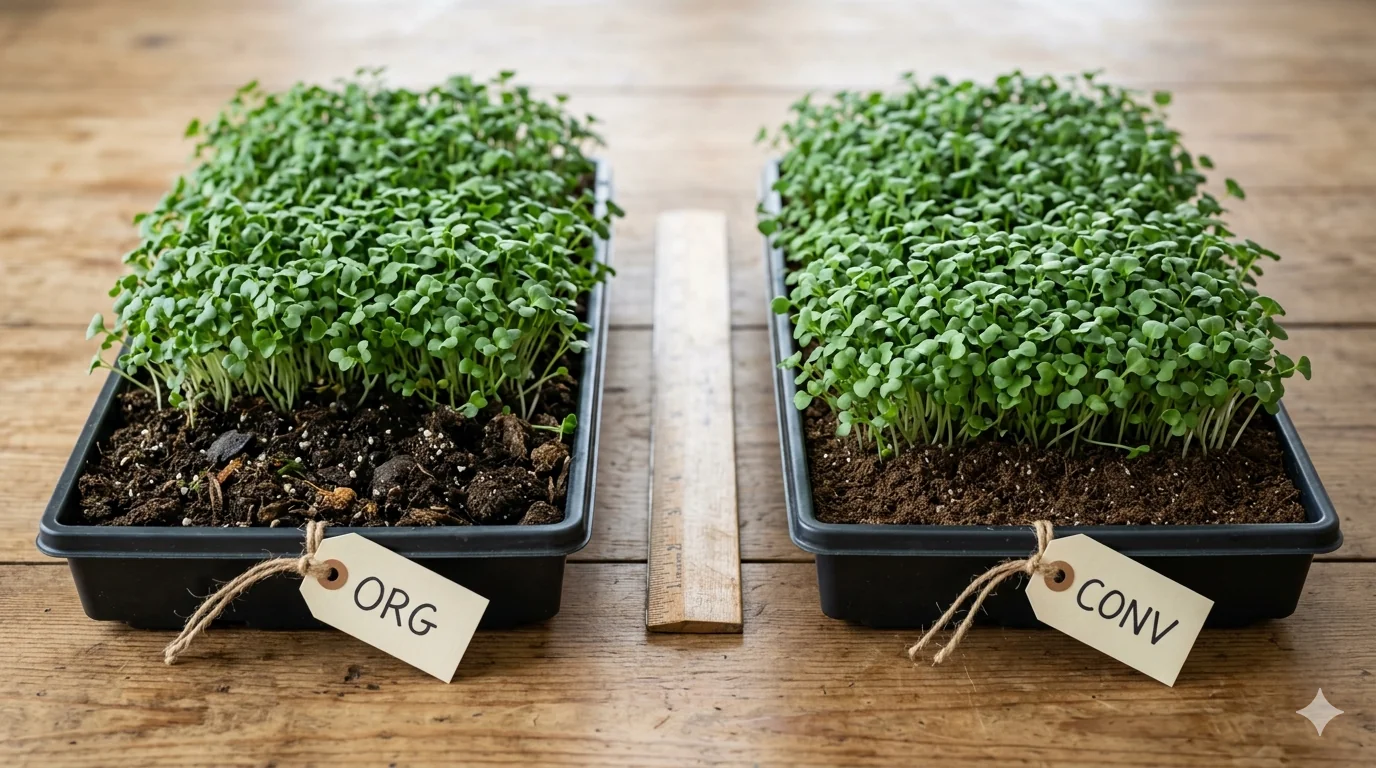
When it comes to microgreens, the organic vs. conventional question matters more than it does for most foods. Here is why: you eat the entire plant. There is no peeling, no cooking, no washing away residues. What is in the soil and on the seed ends up in your body. Let us break down the real differences. 🔍
What "Organic" Actually Means for Microgreens 🌱
For microgreens to be truly organic, three things need to be in place:
- Organic seeds: USDA Organic certified seeds that have not been treated with synthetic fungicides, pesticides, or chemical coatings
- Organic growing medium: Soil or substrate free from synthetic fertilizers and chemical additives
- No synthetic inputs: No chemical pesticides, herbicides, or synthetic fertilizers used at any point during the growing process
At microGREEN FX, we use USDA Organic seeds and grow in quality soil without synthetic chemicals. Every tray follows this standard. No exceptions. 🧑🌾
The Pesticide Problem 🧪
This is the biggest concern with conventional microgreens. Conventional growing operations may use synthetic pesticides and fungicides to prevent mold and pest issues. While these chemicals might be used in small amounts, remember that microgreens are eaten raw, whole, and uncooked.
With mature vegetables, you can peel a carrot, wash a tomato, or cook broccoli to reduce pesticide residues. With microgreens, there is no barrier between the chemical and your body. You eat the entire plant, stem and leaves, exactly as it grew. That is why organic matters more for microgreens than almost any other food. ⚠️
🔬 Why It Matters More for Microgreens
Mature Vegetables
Can be peeled, washed, or cooked to reduce residues
Microgreens
Eaten raw, whole, unpeeled. No way to remove residues
Seed Treatment: The Hidden Issue 🌰
Most people do not think about this, but conventional seeds are often treated with chemical fungicides and coatings before they are even planted. These treatments are designed to prevent mold during germination, but the residues can end up in the plant tissue as the seed sprouts and grows.
USDA Organic seeds are not treated with synthetic chemicals. They rely on natural disease resistance and proper growing conditions to prevent mold. This is one more reason why starting with organic seeds matters. 🌿
Nutritional Differences 💪
Research on organic vs. conventional produce in general shows mixed results. Some studies find higher nutrient levels in organic produce, while others find no significant difference. However, there are a few factors specific to microgreens worth noting:
- Soil health: Organic growing media tend to have more diverse microbial life, which can improve nutrient availability to plants. Learn about living soil vs dead dirt.
- Stress response: Plants grown without synthetic protection sometimes produce more antioxidants as a natural defense mechanism
- No chemical interference: Synthetic chemicals can potentially interfere with the plant's natural nutrient production processes
Flavor Differences 🍽️
Our customers regularly tell us that our microgreens taste better than anything they have tried from other sources. While taste is subjective, there is a reason organic produce often tastes more vibrant. Healthy soil with active microbiology produces plants that develop more complex flavor compounds.
Conventional growing with synthetic fertilizers can produce plants that grow fast and look good but lack depth of flavor. It is the difference between a tomato from your backyard garden and one from a commercial greenhouse. The microgreen world has the same dynamic. Taste the difference with our 27 varieties. 🌻
The Bottom Line 🏆
For most foods, the organic vs. conventional debate has nuance. For microgreens, it is straightforward. You eat the entire plant raw. Whatever is in the soil, on the seed, or sprayed on the leaves goes directly into your body. Organic growing practices eliminate the risk of synthetic chemical exposure.
At microGREEN FX, we do not cut corners. USDA Organic seeds, quality soil, no synthetic chemicals. That is the standard. If you are going to eat something raw and whole, you deserve to know exactly how it was grown. 🌱
Clean food, no compromises 🌿
microGREEN FX grows with USDA Organic seeds and zero synthetic chemicals. Free delivery* in Montgomery County, PA.