📍 Quick Answer
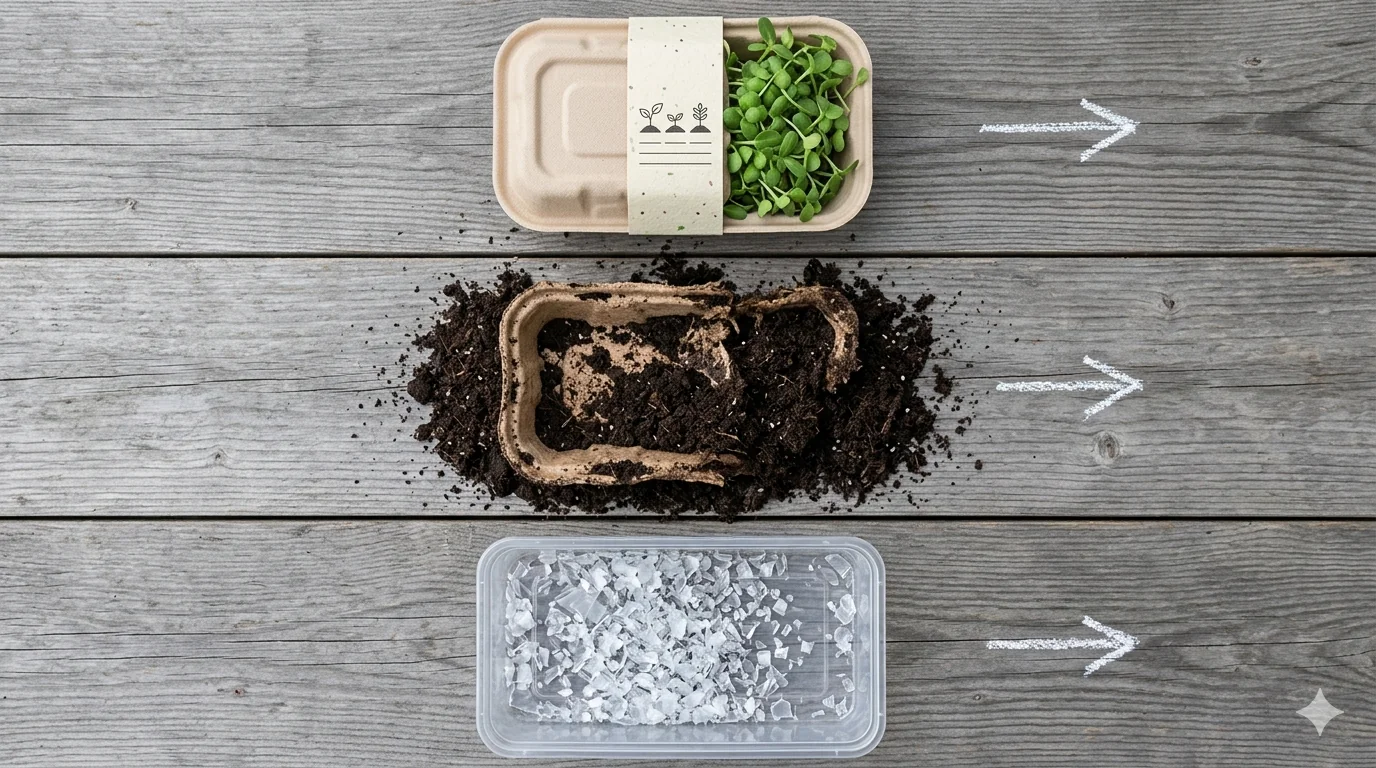
Compostable is the highest standard: the material breaks down into actual compost (organic matter that grows plants) within 90 to 180 days in a defined environment. Biodegradable means the material eventually breaks down via biological processes, but the time frame can be decades and the result is often microplastic. Recyclable means the material can theoretically be recycled, but actual recycling rates depend on your local facility, the material type, and consumer behavior. microGREEN FX uses home-compost-certified containers, the strongest of the three.
You see all three words on food packaging at the grocery store. Compostable. Biodegradable. Recyclable. The marketing copy uses them like they are the same thing. They are not. 🔬
The difference matters because the actual environmental outcome is wildly different. One ends as compost in your garden. One ends as microplastic that sticks around for a century. One depends entirely on whether your county runs the right recycling facility.
Here is the breakdown, in plain language, with the standards each term has to meet.
Compostable: The Strongest Term ✅
- Definition. The material breaks down into compost (organic matter that supports plant growth) within a defined time frame, in a defined environment.
- Two sub-categories. Home compostable (works in a backyard pile, breaks down at ambient temperature, the strongest standard) and industrial compostable (requires high-heat industrial composting facility, weaker standard for home use).
- Time frame. 90 to 180 days for home compostable. Up to 12 months for industrial.
- Result. Soil-enriching compost. No microplastic.
- Certification. Look for BPI, TÜV OK Compost HOME, or equivalent.
- What microGREEN FX uses. Home-compostable certified.
Biodegradable: A Weaker Term ⚠️
- Definition. The material breaks down via biological processes, but with no defined time frame or end-state.
- Time frame. Anywhere from 6 months to 100+ years.
- Result. Often microplastic, especially for "biodegradable plastics" that are still petroleum-based.
- Certification. No required standard. Anyone can call a product "biodegradable" because technically all matter biodegrades eventually.
- Common abuse. "Oxo-degradable" plastics are marketed as biodegradable but break into microplastic in 1 to 5 years and stay in the environment for decades after.
Recyclable: A Conditional Term 🔄
- Definition. The material can theoretically be recycled.
- Reality. Actual recycling depends on your local facility, the specific material, contamination level, and economic conditions.
- Examples that are well-recycled. Aluminum cans (~50 percent), rigid PET water bottles (~29 percent).
- Examples that are poorly recycled. Thermoform PET clamshells (~9 percent), mixed-material flexible packaging (~3 percent), most plastic films (~2 percent).
- The chasing-arrows symbol. Indicates the material type, not whether your local facility actually recycles it.
Why Compostable Wins for Microgreens 🌱
Microgreens are perishable. Most consumers throw the empty package in the trash within 1 to 6 weeks of purchase. The packaging spends almost no time being "useful" before it becomes waste.
Compostable packaging means that 1 to 6 weeks of useful life is followed by 90 to 180 days of breaking down into soil. The total environmental footprint is months, not centuries.
Plastic clamshells flip that math. The 1 to 6 weeks of usefulness is followed by 450+ years in landfill or microplastic distribution. The packaging outlives the consumer who bought it.
How to Read Packaging Claims 🕵️
- "100% compostable" with BPI or TÜV certification. Trustworthy. Will compost in the stated environment.
- "Compostable" without certification. Marketing term, may or may not be true. Look for the standard.
- "Biodegradable" without time frame. Almost meaningless. Could mean 6 months or 60 years.
- "Recyclable" with chasing-arrows symbol. Material is theoretically recyclable. Check your county facility for whether it actually is.
- "Eco-friendly" or "green packaging" with no specific claim. Marketing language, no standard, treat as no claim at all.
A Few Calibrating Questions 🤔
- When you bought packaged food this week, did you check whether the packaging was certified compostable or just marketed as "eco-friendly"?
- Does your county have curbside compost pickup, or do you home compost?
- Would the difference between home-compostable and industrial-compostable change your buying decision?
- When a brand says "biodegradable" without specifying a time frame, does that read as honest to you, or as marketing?
Buy From a Farm That Composts 🌿
microGREEN FX uses home-compost-certified containers on every delivery. Drop in your backyard pile, gone in 6 months.