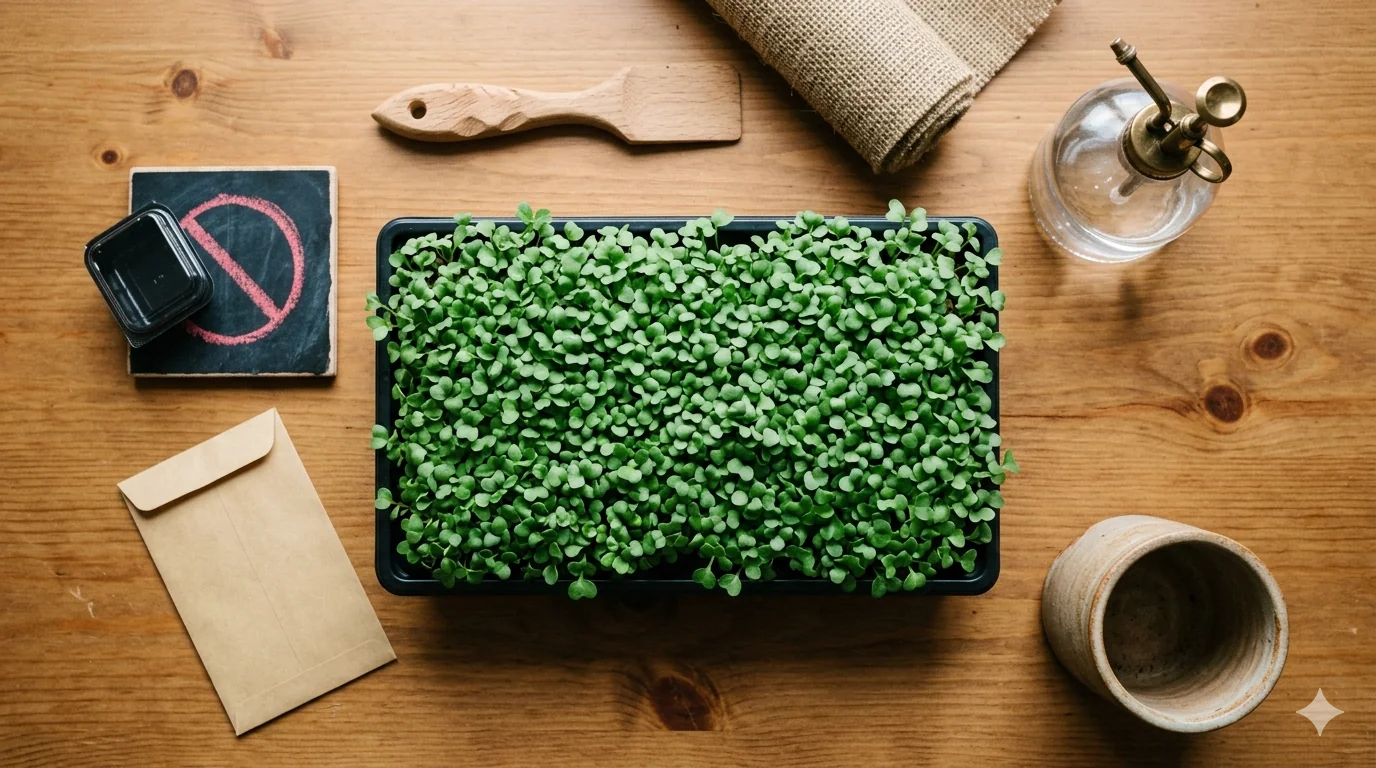
📍 Quick Answer
Petroleum-free microgreen growing means avoiding petroleum-derived inputs at every stage: the growing media (no peat extraction or petroleum-amended soils), the fertilizer (no synthetic petroleum-derived nitrogen), the packaging (no plastic clamshells), and the trays (no single-use plastic). microGREEN FX is petroleum-free across all four. The vast majority of commercial microgreen farms are petroleum-dependent at multiple points and do not advertise the fact.
Most consumers think "natural microgreens" or "organic microgreens" means the entire supply chain avoids petroleum. It does not. 🛢️
A typical commercial microgreen farm is petroleum-dependent at multiple points: peat-based growing media (extraction uses heavy petroleum-fueled equipment), synthetic fertilizers (nitrogen often comes from natural-gas-derived ammonia), plastic clamshells (made from polyethylene terephthalate / PET, a petroleum derivative), and reusable or disposable plastic trays (also petroleum-derived).
Going petroleum-free across all four points is harder, more expensive, and rarely advertised. We did it because we believe the customer who reads the label deserves a label that means something.
The Four Points Where Petroleum Sneaks In 🛢️
- 1. Growing media. Most commercial mixes are peat-based. Peat extraction in Canada uses heavy machinery running on diesel. The peat itself is not petroleum, but the supply chain that delivers it is. We use peat-free MicroThrive Soil with renewable inputs.
- 2. Fertilizer. Most commercial agriculture relies on synthetic nitrogen fertilizer. Synthetic nitrogen is produced via the Haber-Bosch process using natural gas as a feedstock. Even "organic" microgreen operations sometimes use approved-but-petroleum-adjacent inputs. We use vermicompost and natural mineral inputs.
- 3. Packaging. The standard "clamshell" container most microgreens come in is made from PET plastic, a petroleum-derived polymer. Most clamshells end up in landfill or oceans. We use 100% biodegradable, plastic-free containers.
- 4. Growing trays. Standard 10x20" plant nursery trays are polypropylene plastic. We use trays designed for repeated use over many years rather than disposable petroleum-derived single-use options.
Why It Matters Beyond the Marketing 🌍
Carbon footprint. Petroleum-derived inputs each carry their own carbon cost. Stacked across a supply chain, the cumulative footprint of "natural" microgreens grown in peat in plastic clamshells with synthetic fertilizers is meaningfully larger than the petroleum-free equivalent.
Microplastics. Petroleum-derived clamshells degrade into microplastics that end up in soil, water, and human bodies. Going biodegradable cuts that pathway.
Supply-chain resilience. Petroleum-dependent agriculture is exposed to oil-price shocks. A peat-free, biodegradable-packaged operation is more resilient when supply-chain disruption hits.
Customer trust. Consumers who actually care about sustainability can verify a petroleum-free claim by inspecting the packaging, asking about the soil, and reading the label. We make all four answers easy to verify.
Why Most Farms Don't Advertise This 📦
Petroleum-free is hard to claim because it is hard to fully achieve. Even certified-organic farms typically use plastic clamshells (because they are FDA-approved for produce contact and durable in transit) and sometimes peat-based media (because USDA Organic permits it).
Some farms partially commit (e.g., biodegradable packaging but peat-based soil) and let consumers assume the rest. We chose to go all-in on all four points and explicitly publish the practice. That is not a marketing claim, it is what the supply chain actually looks like.
If a microgreen producer is petroleum-free, they will say so on their website, packaging, or social media. If they are silent on the question, they probably are not.
Buy Petroleum-Free Microgreens 🌿
Same-day-harvest microgreens grown petroleum-free across all four supply chain points: peat-free soil, natural fertilizers, biodegradable packaging, reusable trays. Free delivery across SE Pennsylvania.