⚠️ A Quick Note
We are a family-run microgreens farm in Schwenksville, PA, not a medical clinic. The research cited below is presented for general educational purposes. Microgreens are food, not medicine, and they should complement (not replace) advice from your doctor, registered dietitian, or other licensed healthcare provider. Always consult a qualified professional before making dietary changes to address a specific health condition.
📍 Quick Answer
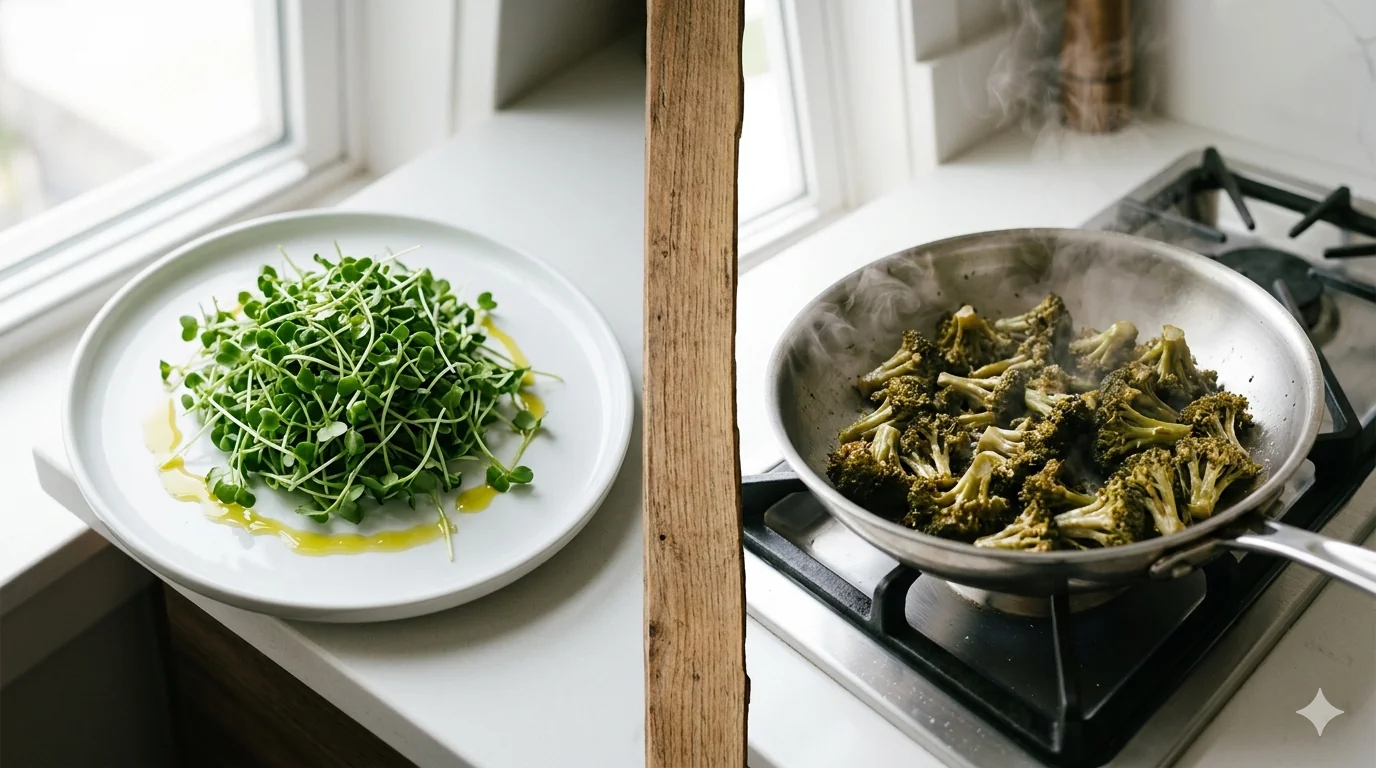
Cooking destroys myrosinase, the enzyme required to convert glucoraphanin into active sulforaphane. A 2008 study in the Journal of Agricultural and Food Chemistry (Vermeulen et al.) found raw broccoli sprout consumption produced 7-10 times more bioavailable sulforaphane than cooked equivalents. The fix is simple: eat broccoli microgreens raw, on top of warm dishes, in salads, in smoothies. Adding mustard or daikon radish microgreens (which contain extra myrosinase) can partially rescue heated broccoli.
For decades, nutritionists told everyone to eat their broccoli, and steaming was the recommended method to preserve nutrients. The advice was right, mostly. Steaming preserves vitamins better than boiling. But it destroys the single most-studied compound broccoli produces. 🔥
That compound is sulforaphane. The bioactive form. The one Johns Hopkins research showed reduces tumor formation in animal studies, lowers fasting blood glucose in diabetic patients, and modulates the Nrf2 cellular defense pathway. The compound that made broccoli a "superfood" in the first place.
Sulforaphane requires the enzyme myrosinase to form. Myrosinase is heat-sensitive. Cooking kills it. Mostly. Which means the way most people prepare broccoli destroys the very thing they are eating it for.
Here is the research and the fix.
The Practical Implications 🥗
- Steamed or boiled broccoli has minimal sulforaphane. The plant still has nutrients (fiber, vitamin C, K, folate, etc.) but the signature bioactive is mostly gone.
- Microwaved broccoli is mixed. Short microwave times (1-2 min) preserve some myrosinase. Long microwave times destroy it. Generally inferior to raw consumption.
- Frozen broccoli is the worst. Commercial frozen broccoli is blanched (briefly boiled) before freezing, which deactivates myrosinase. Dosz & Jeffery (2013) explicitly documented that "commercially produced frozen broccoli lacks the ability to form sulforaphane."
- Raw broccoli microgreens win. Raw consumption with thorough chewing produces 7-10x more bioavailable sulforaphane than any cooked form (Vermeulen et al., 2008).
- Mustard powder rescue. If you must cook broccoli, sprinkling mustard powder or eating it with mustard microgreens can partially rescue sulforaphane formation, because mustard contains its own thermostable myrosinase activity.
How to Eat Broccoli Microgreens Without Cooking Them 🍽️
- On top of warm dishes after plating. Sprinkle a fistful of broccoli microgreens on a finished pasta, soup, eggs, or grain bowl right before eating. Brief contact with warm food does not destroy myrosinase.
- In smoothies (cold base). Blend with cold liquid, fruit, protein. The mechanical breakage activates myrosinase as the cells rupture.
- In salads with vinaigrette. Acidic dressings actually enhance sulforaphane formation slightly.
- On avocado toast. Pile of broccoli microgreens on top of avocado on toast. Classic, photogenic, full sulforaphane.
- In wraps and sandwiches. Add at the end as a fresh layer. Don't toast or grill after adding.
- As a finishing garnish on cooked dishes. Same as #1. The dish is cooked. The microgreens go on top after.
What the Cooking-vs-Raw Research Shows 📚
Vermeulen et al. (2008), Journal of Agricultural and Food Chemistry - the canonical study on this question. Researchers fed human participants either raw or cooked broccoli sprouts and measured sulforaphane bioavailability via urinary excretion. Result: raw consumption produced 7-10x more bioavailable sulforaphane than cooked equivalents.
Conaway et al. (2000), Nutrition and Cancer - earlier research demonstrating that boiling and steaming both reduced glucosinolate content of cruciferous vegetables, with boiling being worse than steaming.
Dosz & Jeffery (2013), Journal of Functional Foods - showed that mustard powder added to cooked broccoli partially restored sulforaphane formation, because mustard contains its own active myrosinase that can compensate for the destroyed broccoli enzyme.
The mechanism: myrosinase is a beta-thioglucosidase enzyme. It is denatured (loses its 3D structure) by sustained heat above approximately 60°C / 140°F. Boiling water at 100°C destroys it within minutes. Steaming at 100°C is gentler than boiling but still destroys most myrosinase activity over typical cook times.
📚 Cited Research
- Vermeulen M, et al. (2008). Bioavailability and kinetics of sulforaphane in humans after consumption of cooked versus raw broccoli. Journal of Agricultural and Food Chemistry, 56(22):10505-9.
- Conaway CC, et al. (2000). Disposition of glucosinolates and sulforaphane in humans after ingestion of steamed and fresh broccoli. Nutrition and Cancer, 38(2):168-78.
- Dosz EB, Jeffery EH. (2013). Modifying the processing and handling of frozen broccoli for increased sulforaphane formation. Journal of Food Science, 78(9):H1459-63.
- Dosz EB, Jeffery EH. (2013). Commercially produced frozen broccoli lacks the ability to form sulforaphane. Journal of Functional Foods, 5(2):987-90.
Get Microgreens Designed for Raw Consumption 🌿
Same-day-harvest broccoli microgreens delivered free across SE Pennsylvania. PA Preferred certified, peat-free, pesticide-free. Built for the way sulforaphane research says to eat them.