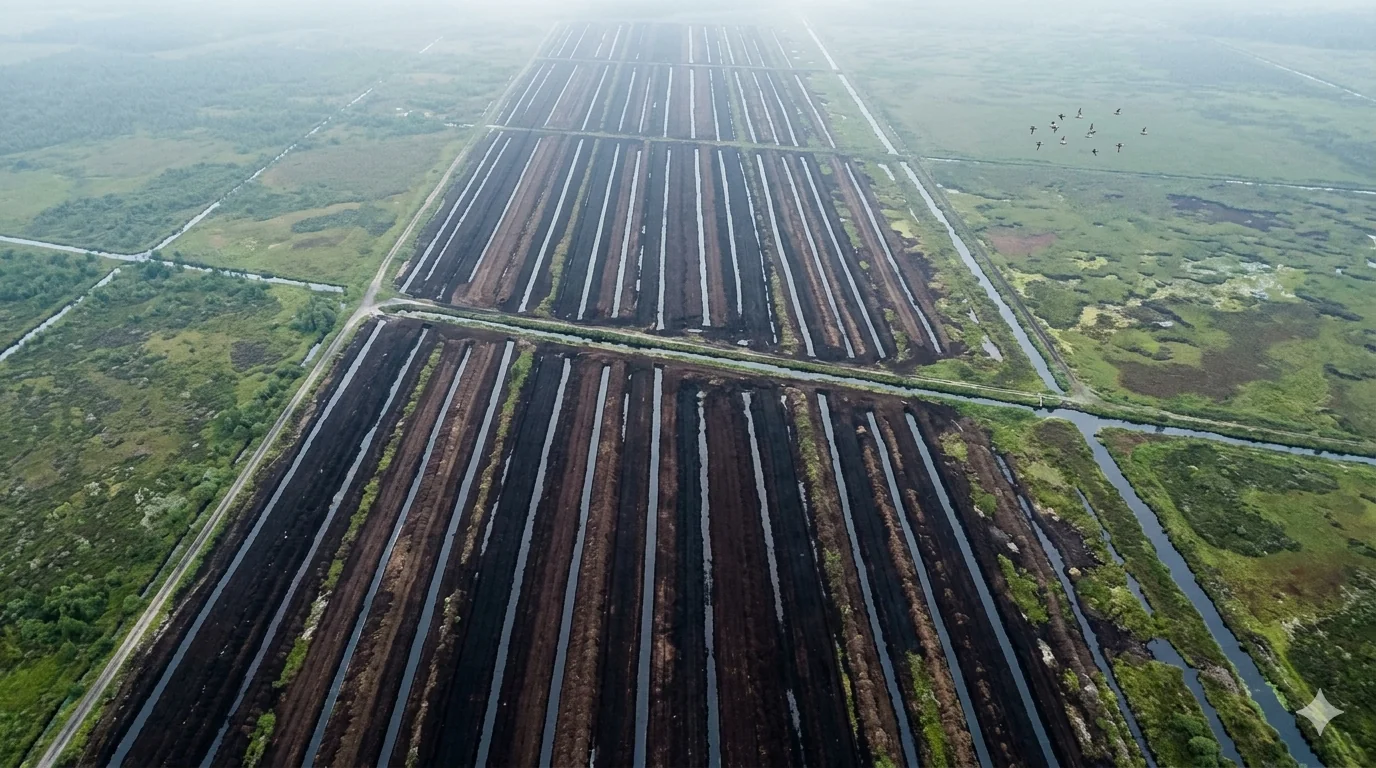
📍 Quick Answer
Commercial peat extraction is environmental destruction at industrial scale. A foot of peat takes 300 years to form; a meter takes 1,000. Extraction drains the bog, exposes ancient carbon to oxygen (releasing it as CO2), destroys habitat for endangered species like the curlew and large heath butterfly, and degrades watersheds that supply drinking water to millions of people. The UK is legislating a peat retail ban for 2026 because of this. Most US horticulture still uses peat from drained Canadian, Irish, or northern European bogs.
Most gardeners who buy a bag of "premium peat moss" at Home Depot have no idea what that bag actually represents. They see brown fluffy material, marketed as a soil amendment. What they are holding is a piece of an ecosystem that took thousands of years to form, was drained and stripped in a few weeks, and is gone forever on any human timescale. 🌍
The UK government is legislating a retail peat sales ban for 2026 specifically because of the cumulative damage. The Republic of Ireland ended industrial peat extraction in January 2021. The European Commission has referred Ireland to the European Court of Justice for failing to protect over 100 Special Areas of Conservation peat bogs. This is not a fringe environmental position. This is mainstream science and policy.
And yet most US horticulture, including 95%+ of commercial microgreen production, still runs on peat. Here is the actual scale of damage that supply chain represents.
What Actually Happens When a Bog Is Extracted 🚧
Step 1, Drainage. Channels are dug to lower the water table. The bog's natural waterlogged anaerobic conditions are destroyed.
Step 2, Vegetation stripping. The living layer (sphagnum moss, sundew, cottongrass, etc.) is removed.
Step 3, Excavation. Heavy machinery scrapes peat layers off the bog. Modern operations use industrial vacuum harvesters that strip thin layers across thousands of acres.
Step 4, Carbon release. Ancient organic carbon, locked away from oxygen for thousands of years, immediately starts oxidizing into CO2. A single drained hectare can emit 5-30 tonnes of CO2 per year for decades after extraction.
Step 5, Habitat collapse. Species that depend on the wet peatland mosaic (curlews, hen harriers, large heath butterflies, bog bush crickets, water voles) lose breeding ground. Local extinctions follow.
Step 6, Watershed degradation. Drained peat releases dissolved organic carbon into runoff. Water flowing off the bog becomes brown and acidic. Downstream water utilities pay more to treat it.
The Government Response Around the World 🏛️
- United Kingdom: retail peat ban being legislated for 2026, full professional sector ban targeted for 2030. DEFRA explicitly cited "Peatlands are the UK's largest carbon store" as the reason.
- Republic of Ireland: Bord na Mona ended all peat harvesting on its lands January 2021. Peat briquette production ended 2024. EU Commission has referred Ireland to the European Court of Justice over peatland conservation failures.
- European Union: Wetlands International has flagged horticultural peat extraction as one of the top peatland threats. Multiple member states are pursuing tighter restrictions.
- United States: No federal restrictions. Most US peat is imported from Canada's vast bog systems, regulated provincially with much weaker conservation requirements than the UK or EU. Industry self-regulates via "Veriflora" certification, which environmental groups argue is insufficient.
The Numbers on Peat Extraction Damage 📚
Peat formation rate: 0.5-1 mm per year. (IUCN UK Peatland Programme.)
Land coverage: peatlands cover only 3% of Earth's land surface but store ~30% of all global soil carbon, more than every forest on Earth combined. (UNEP Global Peatlands Assessment, 2022.)
CO2 from drained peatlands: ~1.9 gigatonnes/year globally. That equals 5% of all human-caused greenhouse gas emissions, from just 0.3% of land area. (IUCN.)
Tropical peat fires (Indonesia, 2015): emitted 1.62 billion tonnes of CO2 in a single fire season, more than the entire annual output of the United States economy on peak days. (World Resources Institute.)
UK drinking water: ~70% of UK drinking water comes from catchments dominated by peatland habitat. Drained peat bogs degrade water quality and increase treatment costs downstream. (IUCN UK Peatland Programme; Xu et al., 2018, Nature Sustainability.)
Wildlife loss: the curlew (Britain's largest wading bird) has crashed >60% since the 1980s due to peatland loss. The large heath butterfly's range contracted 58% from 1976-2014. The hen harrier is among the UK's most endangered breeding raptors. Bog bush crickets, raft spiders, water voles, sundew, sphagnum moss species, all peatland-dependent and all in decline. (Butterfly Conservation; RSPB; Wildlife Trusts.)
Horticulture's role: the Wildlife Trusts estimate UK horticulture consumes 760,000 cubic meters of peat per year. Most of it goes into bagged compost and commercial growing mixes, the same kind of mix in your local microgreen farmer's grow room.
📚 Cited Research
- IUCN UK Peatland Programme. Carbon and water service factsheets.
- UNEP Global Peatlands Assessment. (2022).
- Xu J, et al. (2018). Hotspots of peatland-derived potable water use identified by global analysis. Nature Sustainability, 1:246-253.
- Butterfly Conservation UK. Species distribution data.
- World Resources Institute. Indonesia 2015 peat fire emissions analysis.
- Wildlife Trusts UK. Peatland and Compost briefings.
Buy From a Peat-Free Farm 🌿
Same-day-harvest microgreens grown in microGREEN FX MicroThrive Soil, peat-free, petroleum-free, pesticide-free. Free delivery across SE Pennsylvania.