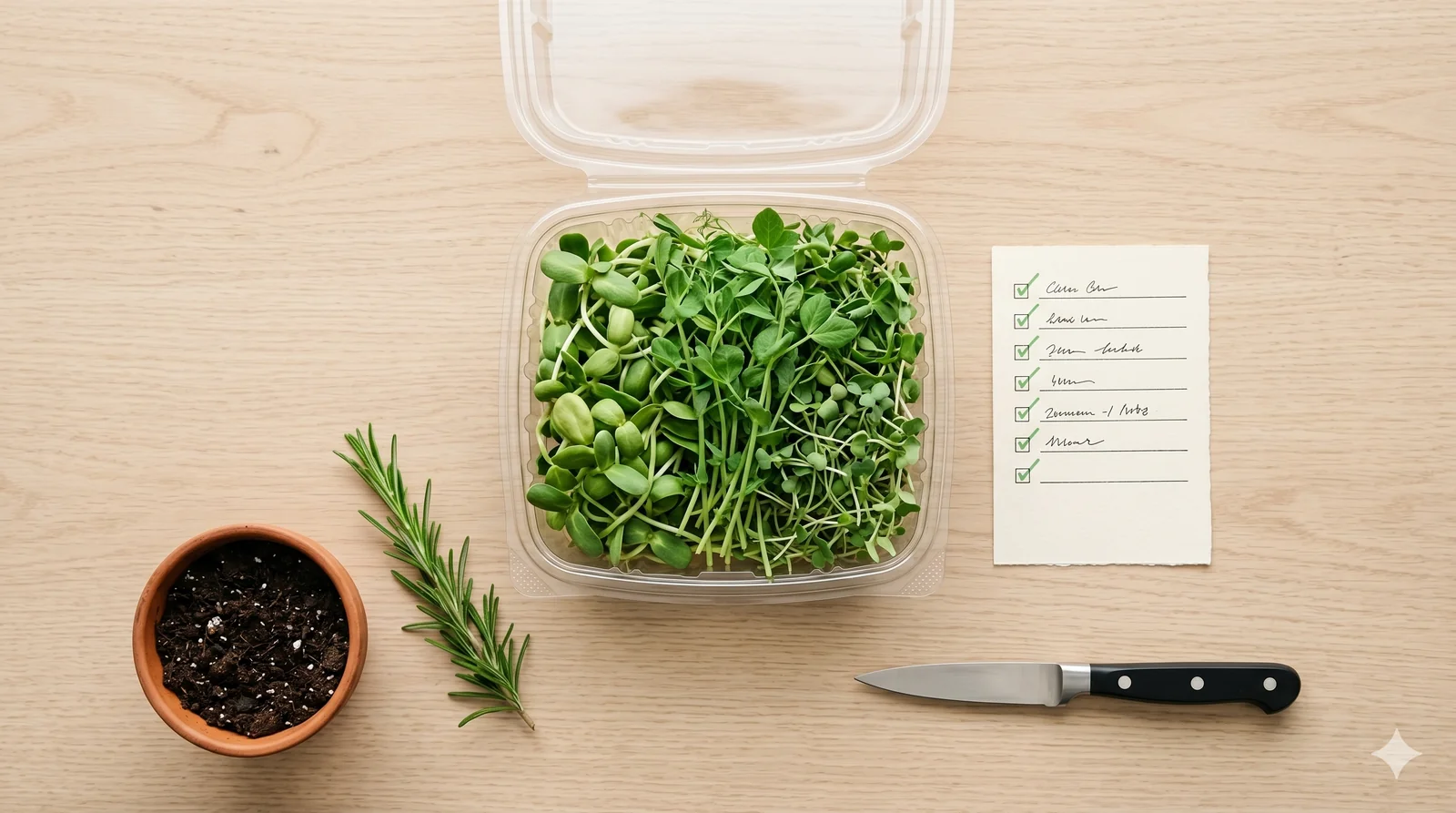
⚡ TL;DR
Apply six questions to any minority-owned microgreens farm: seed and soil transparency, harvest-to-delivery time, packaging, certification posture, direct voice, and operational detail. Specificity is the signal. A farm that gives clean answers earns the order. A farm that dodges three or more is selling a story, not a product.
Most buyers who go looking for a minority-owned microgreens farm in Pennsylvania are a little uncomfortable while they search. ✅ They want to support the right business. They also do not want to be sold a label instead of a product. The discomfort is honest and the fix is simple. Apply a checklist.
Have you ever asked your microgreens supplier where their seeds come from. What soil they grow in. What water they use. What time the leaf was cut. Most buyers have not, and not because they do not care, but because the answers are usually vague enough that the conversation stops being useful. The point of this article is to make the conversation useful again. By the end, you will be able to evaluate any minority-owned farm in Pennsylvania, including microGREEN FX, with the same six questions. The reader is being upgraded, not lectured.
Quick framing before the list. Sergio Markarian here. I co-founded microGREEN FX in Schwenksville with my wife Celine. Three kids, one farm, peat-free soil, USDA Organic seeds, purified water, plastic-free packaging, and a software stack we wrote ourselves. Family Herbalist credential, the entry step toward Master Herbalist. Everything below is a checklist I would hand to a customer evaluating a competitor down the road. We are confident enough in the answers to publish them.
1. Are the Seed and Soil Sources Transparent? 🌱
This is the cheapest test and the most revealing. A real farm publishes seed origins, soil composition, and water source on the website. A token farm publishes a founder photo and a story.
USDA Organic seeds are sourced from certified suppliers and the certification number is verifiable. Mystery commodity seeds are bought in 25-pound sacks from whichever wholesaler is cheapest that month. The germination rate, the chemical treatment history, and the genetic stability are all unknown. A microgreens tray amplifies whatever was on the seed because there is almost no soil contact time, so the seed source is more important than the soil for chemistry, and the soil is more important than the seed for nutrition. You want both answered.
Soil mix matters because peat moss is a petroleum-adjacent extraction product harvested from peat bogs that took centuries to form. The bog is destroyed in the harvest. A peat-free blend is harder to formulate but the carbon math, the water-holding profile, and the mineral content are all under the farmer's control. microGREEN FX has run a peat-free living soil blend since early 2022, reformulated from our original blend after testing. Water is purified through a multi-stage filter, not municipal tap with chlorine and chloramine. Seeds are USDA Organic at source.
Ask the farm. If the answer is "we use natural stuff" or "we follow traditional methods," you have your answer. Specificity is the signal.
What To Look For On The Website 🔍
A real farm will have a page or a paragraph that names the seed supplier or at least the certification body, names the soil components or at least the peat status, and names the water treatment. None of that is proprietary. It is the equivalent of a coffee roaster naming origin and process. Farms that hide these basics are usually hiding something more expensive.
2. Is the Harvest-to-Delivery Time Stated Explicitly? ⏱️
Same-day harvest is a measurable claim. It is also the single biggest predictor of how long the greens last in your fridge, how much vitamin C is intact when you eat them, and whether you taste anything at all. The cut-to-cold window, in hours, is a number a real farm can give you on demand.
microGREEN FX cuts on the morning of delivery. The trays are in the customer's kitchen inside 8 hours of harvest. The delivery van runs a Montgomery County route on Tuesdays and Fridays, and the freshness data sits in our Montgomery County freshness write-up. Schwenksville to Harleysville is 20 minutes. King of Prussia is 25. Most addresses see the leaf within 90 minutes of the cut.
What happens when you only get vague answers about how the food on your plate was grown. The honest answer is that the cut-to-cold window is probably broken and the farm has reasons not to publish it. Bagged supermarket greens were cut 4 to 12 days ago in California or Arizona, gas-flushed for shelf life, and trucked across the country. A local farm that cannot beat that timeline on its home turf has a problem.
The Question To Ask On The Phone 📞
Pick up the phone or send a text. Ask, "What time were the trays I am about to receive cut, and what time will they arrive at my door?" A real farm answers in numbers. A farm that buys its trays from a wholesaler and resells them locally cannot answer at all, because the timestamp is not theirs. That single question separates growers from resellers in under thirty seconds.
3. Is the Packaging Accountable? 📦
Packaging is a cheap way to read a farm's actual values. Plastic clamshells are the default because they are cheap. Plastic-free biodegradable containers cost more, weigh more, and ship slower. A farm that chose them anyway is making a statement about what it owes the soil that grew the product.
microGREEN FX has used plastic-free biodegradable containers since day one. The trade-off is real, the cost difference comes out of margin, not out of price, and the customer gets a tray that composts in roughly 90 days instead of sitting in a landfill for 400 years. There is no upcharge for the choice.
Ask the farm what its packaging is made of and where it ends up. The farms that can answer in one sentence have already thought about it. The farms that need to check on the answer probably have not.
Why The Container Choice Tells You About The Soil Choice 🌍
The same farm decisions tend to cluster. A farm that paid extra for biodegradable packaging usually paid extra for non-petroleum soil components. A farm that paid extra for non-petroleum soil components usually paid extra for organic seeds. A farm that defaulted to plastic clamshells usually defaulted on the other two as well. None of this is a guarantee, but the cluster shows up often enough to use as a screen.
4. Are the Standards Ongoing or Just a One-Time Certification? 📜
USDA Organic is a useful baseline. It is also, increasingly, a paperwork-driven label. The annual renewal verifies that you filled out the renewal forms, kept the receipts, and paid the inspector. It does not verify that you are doing better than the minimum, and a growing share of small farms are now exceeding the certification's day-to-day standards while declining to renew.
microGREEN FX held USDA Organic through 2024. We declined to renew for 2025. The reason was simple. The standards on the farm now exceed what the certification verifies, the renewal paperwork was the weakest signal of quality we had, and we would rather invest the certification fee back into seed quality and software. Seeds are still USDA Organic at the source. Soil is still peat-free. No synthetic pesticide, herbicide, or fungicide has ever been used on the farm.
Why Direct Evaluation Beats Third-Party Validation ⚖️
A buyer who applies this checklist consistently to every farm gets a fair comparison. A buyer who outsources the evaluation to a directory or a partnership inherits whatever bias that directory or partnership had baked in. Minority farms in particular get held to a different bar by default in third-party reviews, which is why direct customer evaluation matters more here than in most categories.
That is why microGREEN FX publishes everything on the public site. The shop page, the order page, the subscription page, the soil, the seeds, the routes, the prices. Verify it yourself.
5. Does the Farm Have Its Own Voice? 🗣️
This is the tokenization test. Tokenization happens when a minority farm only shows up inside third-party diversity directories, partnership pages, or "support our minority growers" landing pages, without operating its own brand, voice, website, customer list, or product page. The buyer is paying for the label, not the farm. The farm is the supplier of a story to a marketing platform.
Real minority farms have direct customer contact. Their founder writes the blog. Their founder takes the texts. Their founder runs the route in person on busy weeks. The relationship is grower-to-customer, not grower-to-platform-to-customer. The platform may help with discovery, but the platform is not the relationship.
microGREEN FX is founder-run. Sergio Markarian texts customers directly. Celine handles the bookkeeping and packaging. The kids help on harvest days. The order page lives on our domain. The subscription page lives on our domain. There is no third-party diversity middleman taking a slice of the order or a slice of the credibility. The farm's voice is its own.
If the farm you are evaluating only appears inside someone else's directory, send a direct message to the founder and see how long the reply takes. A real minority farm answers in person. A token one routes you back to the directory.
The Direct Contact Test 📱
Try this. Open the farm's website. Find the founder's name. Search for that name on a search engine and see whether the first page of results is the farm's own pages or a string of partnership posts where the farm is featured but not authored. The first version is operating an independent business. The second version is operating inside someone else's marketing.
6. Can the Farm Describe Its Process in Detail? 📊
This is the deepest signal in the checklist. Vague answers about ag practice are almost always cover for not knowing. Detailed answers, in numbers, are cover for nothing.
What does detailed look like. pH targets per variety, between 5.8 and 6.5 for most species, tighter for sensitive ones. Daily light integral targets, measured in moles per square meter per day. Blackout day counts per variety, three to four for small seeds, five to seven for larger seeds. Watering frequency calibrated to ambient humidity. Environmental sensor logs going back to the start of the year. Harvest yield by tray by week. Temperature data on the cooler. None of this is fancy. It is the operational floor for a farm that takes the work seriously.
microGREEN FX runs all of this through GLAP, short for Microgreens Grown Like A Pro, an app we built for the farm and licensed to other working farms. It handles pH per variety, light schedules, watering schedules, lifecycle stages, environmental sensors, team task management, and inventory across 17 languages. Built by a working farm for working farms. The detail is not the point. The detail is the by-product of doing the work.
The "Oh, So It Teaches You How To Water" Moment 💧
One last thing. If you find yourself, as a buyer, instinctively reducing competence you did not expect, you have spotted your own bias. Real comment we received once. "Oh, so it teaches you how to water." The reaction reduces the full feature surface, the multi-language support, the environmental sensor stack, the task management system, the lifecycle modeling, down to the smallest task in the app, because that smallest task is the one the listener felt comfortable describing. That instinct shows up in every industry, but it shows up most often when the founder is a minority. Notice it when it happens to you. The notice is the upgrade.
Apply the six questions to every farm. Including ours. The farms that answer cleanly earn the order. The farms that do not, do not. That is the standard.
Why The Tech Conversation Matters For Quality, Not Vanity 📱
Software is not a flex. It is a record-keeping discipline. The farm that logs pH per variety on each tray is the farm that catches a slow drift before it ruins a crop. The farm that logs daily light integrals is the farm that knows why one harvest tasted hotter than another. The farm that logs harvest yield by tray is the farm that can spot a soil batch going stale before the customer ever sees a soft leaf. Detail is the by-product of caring whether the work is repeatable.
The Short Version of the Checklist ✅
Print this and bring it to whatever farm you are considering, ours or anyone else's.
📋 The 8-Point Buyer Checklist
- 1 Seed source published, with the certifying body named
- 2 Soil mix published, with peat status disclosed
- 3 Water source published, purified or municipal
- 4 Harvest-to-delivery time stated in hours
- 5 Packaging material stated, plastic or biodegradable
- 6 Certification posture stated, current or declined and why
- 7 Direct customer contact, founder reachable
- 8 Operational detail available on demand, in numbers
If a farm gives clean answers on all eight, the order is safe. If the farm dodges three or more, the order is a story you are buying, not a product. More on the only 100% minority-owned microgreens farm in Montgomery County. Same-day-harvest geography across Montco.
The Reader Is The Standard, Not The Story 🎯
The whole point of this checklist is to put the buyer back in charge of the evaluation. Diversity directories, partnership pages, and "support our minority growers" campaigns can be useful for discovery, but they should never replace the buyer's own judgement on quality. A farm that earns the order through a directory and would not earn it through a checklist is a farm that needs the directory more than the customer needs the farm.
The opposite is also true. A farm that earns the order through the checklist does not need the directory at all. The product makes the case. The founder makes the case. The transparency makes the case. The directory becomes a discovery layer, not a credibility layer, which is the right division of labor.
microGREEN FX runs on the second model. The site, the order page, the subscription page, the route map, the blog, and the founder's name are all on one domain, all under one operator, all reachable in one click. Order from us if the answers above hold up. Order from a competitor if their answers hold up better. The standard is the standard.
🛒 Ask Us The Six Questions Yourself
Want the full delivery map? 100+ delivery locations across SE PA →
Frequently Asked Questions 🤔
How do I verify a minority-owned microgreens farm in Pennsylvania is legitimate? +
Is microGREEN FX a minority-owned farm in Montgomery County, PA? +
Why did microGREEN FX drop USDA Organic certification in 2025? +
What is tokenization in minority farm marketing and how do I avoid it? +
What technology does microGREEN FX use to grow microgreens in Pennsylvania? +
How do I order from microGREEN FX directly without going through a third-party platform? +
Related Reading 📚
The Only 100% Minority-Owned Microgreens Farm in Montgomery County, PA
Why the sentence is rare, and what changes for the buyer.
🌿Freshest Microgreens in Montgomery County
Same-morning cut, same-day delivery, full Montco route.
⏱️What 8 Hours From Cut to Door Actually Changes
The plant biology behind the freshness window.
💵The Hidden Cost of "Fresh" Greens at the Supermarket
What happens to the leaf between Salinas and your shelf.