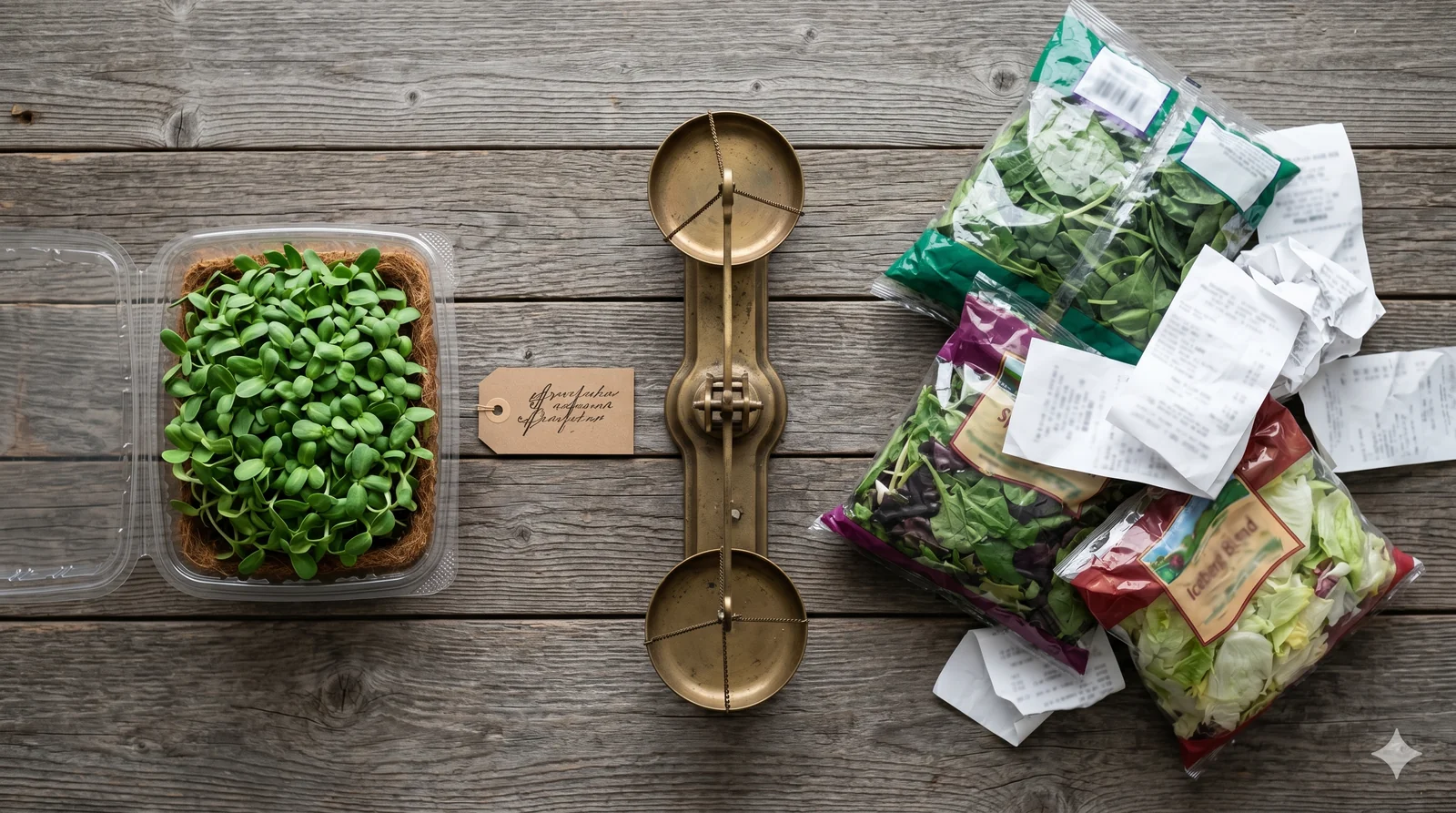
Most household grocery budgets list "salad and greens" at $20-25 per week. The receipt shows $24. The number that matters is what landed in the trash.
USDA loss-adjusted intake data, the cleanest national dataset on what fresh produce actually gets consumed versus discarded, puts bagged-salad household waste at 30 to 40 percent. Wegmans and Acme report similar numbers internally. The bag opens, the leaves go translucent in three days, the family eats out instead, the rest goes brown.
Real cost per ounce eaten, on a $24/week bagged-salad budget with 35 percent waste: roughly $0.96 per usable ounce. That is the number to compare against.
What a Microgreens Subscription Actually Costs Per Eaten Ounce
microGREEN FX weekly subscription: $20 for 8oz, harvested the morning we deliver, two-week fridge life. Household waste rate on the trays we have followed up on: under 5 percent. Most goes into a smoothie before it has the chance to fade.
Real cost per ounce eaten, on a $20/week subscription with 5 percent waste: roughly $2.63 per usable ounce.
That number is higher than bagged salad. Up front. So why are we writing this article? Because nobody who switches goes back, and the reason is not the math at the top.
The Math At The Bottom
One ounce of fresh microgreens delivers the nutrient content of roughly 2.5 pounds of mature vegetable. Forty grams of dry microgreen biomass equals the vitamin C of a kilo of romaine, the vitamin K of half a head of kale, and concentrations of polyphenol antioxidants mature plants do not carry at all. The "per ounce eaten" comparison breaks down because the two products are not nutritionally equivalent.
Recalculate the math on a per-nutrient basis and the bagged salad costs five to ten times more for the same amount of usable vitamin and mineral intake. That is the math that turns subscription customers into long-term customers.
Three Other Costs Bagged Salad Carries That Nobody Lists
Driving cost. Average grocery run consumes about $4 in gas plus 30 minutes of time. A subscription delivery is free, on a route we already drive past your door.
Plastic disposal. The clamshell costs the manufacturer $0.12. The full lifecycle (manufacturing, transport, recycling capacity below 10 percent for #1 PET, microplastic remediation) is closer to $1.50 per clamshell once externalities are priced. You do not pay it on the receipt. Society pays it.
Spoilage stress. The unspoken household tax of opening the fridge and finding salad that turned. People who have stopped fighting that ritual report it as one of the surprise benefits of switching.
Where the Subscription Loses
Honest about it. If you eat a head of iceberg every week and the iceberg never goes brown, our subscription does not save you money. It does not save anybody money in absolute dollars. The argument was never absolute dollars. The argument is dollars per nutrient delivered, dollars per ounce eaten, and dollars in dignity from not having to fight your fridge.
If you are an iceberg-only household, stay with iceberg. If you eat varied fresh greens and watch a third of them spoil every week, the subscription math is in your favor on every dimension that matters.
The Comparison Table
Here is the side-by-side, on a $20-24/week budget, family of four:
Bagged salad, $24/week: 30-40% waste, 7-12 days post-harvest by the time you see it, plastic clamshell, driving cost not included, ~$0.96 per ounce eaten.
microGREEN FX subscription, $20/week: under 5% waste, harvested the morning of delivery, plastic-free biodegradable container, free door delivery, ~$2.63 per ounce eaten but with 4-40x the nutrient density.
Same dollar bracket. Same fridge real estate. Different food.
Pick a Cadence and Test It
The fastest way to settle the math in your own household is to switch for a month. Most households know by week three whether the subscription belongs in the routine. Pause anytime, cancel in two clicks. We do not call to retain you. The trays earn the renewal every week or they do not.