📍 Quick Answer
The 2022 USDA Census of Agriculture counted 579 farms and 1,159 farm producers in Montgomery County, PA. Fourteen of them were not white. Five Black or African American, six Asian, three reporting more than one race. Zero Native American. That is 1.2 percent of the county's farmers in a county that is roughly 28 percent people of color. As far as we have been able to see, microGREEN FX is the only 100 percent minority-owned microgreens farm in the county. We would rather you verified that yourself than believed us.
Most people guess low when we ask them. They usually guess forty or fifty. 🌾
The real number is fourteen. It comes from the USDA, not from us, and anyone can pull the same county profile we did.
We are not writing this to be congratulated. We are writing it because a number that small tells you something about a food system, and most people have never been shown it.
One thing before the numbers, because it matters and we would rather say it up front than have it assumed. None of this is a complaint about white farmers. The families running the other farms in this county work brutally hard, most on thin margins, plenty of them fighting to hold onto land their grandparents bought. Their success is not the reason our number is fourteen. Nobody has to lose anything for that number to get better, and nothing in this article asks them to.
The Count, Straight From the Census 📊
Montgomery County, PA. 2022 Census of Agriculture. 579 farms, 1,159 producers. The producer breakdown:
- White: 1,145 producers
- Asian: 6 producers
- Black or African American: 5 producers, across 5 farms
- More than one race: 3 producers
- American Indian or Alaska Native: 0
- Native Hawaiian or Pacific Islander: 0
- Hispanic, Latino or Spanish origin (any race): 4 producers
Montgomery County is about 9 percent Black. Its farmers are 0.43 percent Black. That is a twenty-fold gap, and it is not a local quirk. Statewide, Pennsylvania has 90,032 producers and 92 of them are Black. Nationally, Black producers are 1.4 percent of all US producers and bring in 0.5 percent of US agricultural sales, down another 4 percent since 2017.
In 1920 there were 925,000 Black-operated farms in this country, about 14 percent of all American farms. The farming skill did not disappear. Access to credit did.
That part is not our opinion and it is not a grievance. It is settled record. The USDA was sued over discrimination in its own farm loan programs and settled, twice, in what became one of the largest civil rights settlements this country has produced. The decline traces back to a lending desk, not to the neighbors. That distinction is the whole point, and it is why this article is not pointed at any farmer.
Do Not Take Our Word For It. Go Count. 🚶
We say we are the only minority-owned microgreens farm in Montco. That is a claim, and claims should be cheap to check. So check it.
- Walk your market on a Saturday. Skip the bakers, the soap, the kettle corn. Count only the people who actually grow.
- Ask each one where they grow. Not where they live. Where the field or the greenhouse is.
- Then do it again at a market one town over. What you are looking for is not one missing face at one table. It is how consistent the pattern stays from town to town, market to market, across the whole county.
- Ask whether that matches where you live. Montgomery County is roughly 28 percent people of color. The people growing its food are not, and it does not vary much by zip code. That consistency is the actual finding.
If you find a minority-owned microgreens grower in this county that we have missed, tell us. We will name them here. We would genuinely rather be wrong about being the only one. Being the only one is not the win. It is the problem.
The Higher Standard, In One Short Story 🤝
Here is why the number matters beyond trivia. Small farms rarely disappear in one dramatic moment. They get squeezed out one judgment call at a time.
For two years we supplied a CSA and built the microgreen side of it up alongside them. We also sent our own retail customers their way, at a lower margin to us on every one of them. We did that on purpose. It was a non-profit farm and we wanted the whole thing to work, not just our part of it.
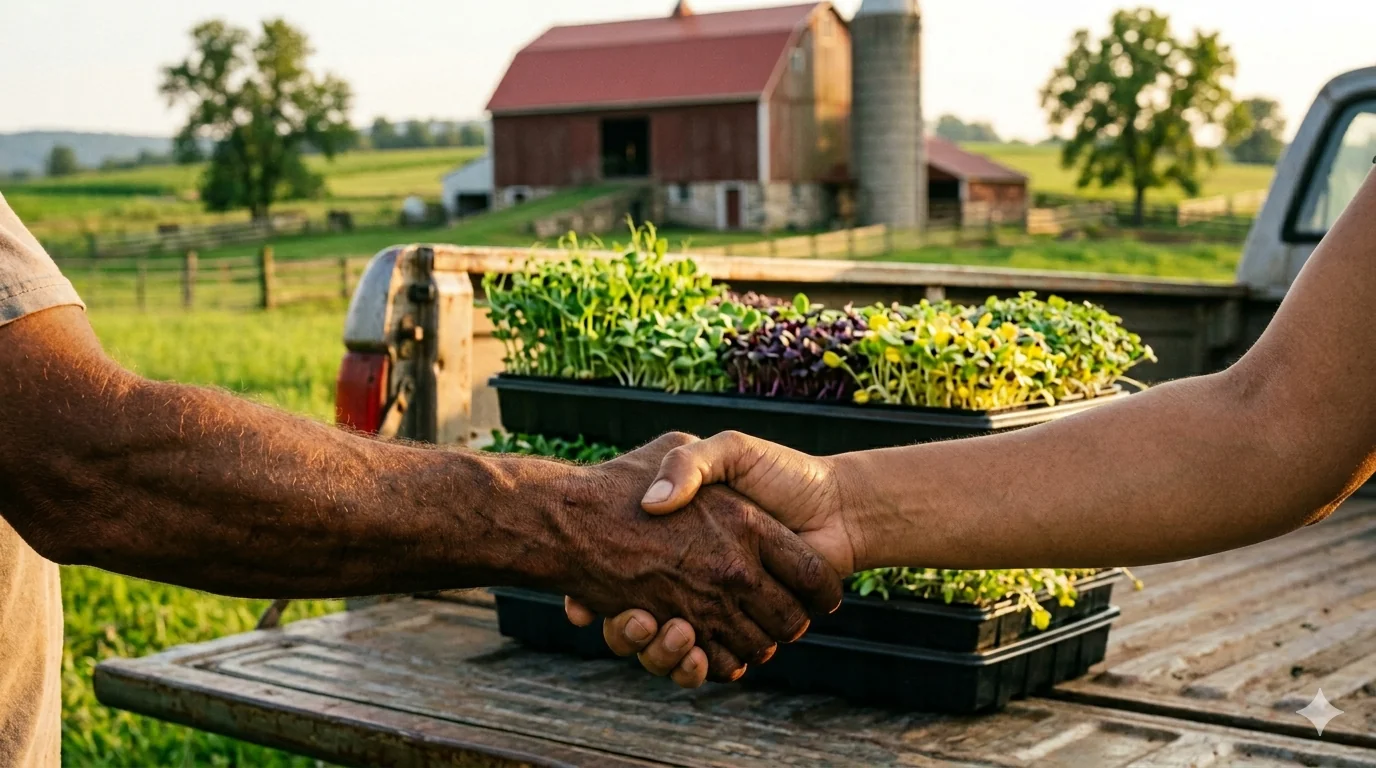
It was a handshake deal. Then the group of clients we had built together was handed to a non-minority farm.
The reasons we were given: we had been late on one delivery a year earlier, in the weeks after our third child was born. And one of our containers had gone missing once at their pickup, on their end, in two years of deliveries.
Nothing about the quality. Nothing about the greens themselves.
We are not going to tell you what was in anyone's head when that call got made, because we do not know and we will not pretend to. We will just give you the ledger and let you weigh it. Two years of supply. Our own customers handed over at a loss to help a non-profit stay standing. One late morning during a newborn. One container they misplaced. That was the whole account, and it came out against us.
But not for the other vendors. Goods went missing from those pickups regularly, from vendors who had delivered the correct amount every time. Nobody lost an account over it. Each time, they were worked with to get the missing stock replenished. Same pickup, same missing product, different response.
This Is Not a Story About White Farmers ⚖️
We want to be precise, because the lazy version of this article helps nobody.
That is not how it has gone everywhere else. In our other partnerships, when product comes up short the conversation is some version of "okay, what happened and how do we fix it." Nobody has ever ended a two-year relationship over a delivery that ran late a year prior.
The overwhelming majority of people in this industry are not holding minority farmers to an impossible bar. Most are decent, most are tired, and most are just trying to get their own product out the door. But it only takes a few, repeated across a lot of small decisions, before the difference shows up in a census table.
So let us be plain. No individual farmer built this gap, and no individual farmer can close it. If you are reading this and you farm, you inherited the same food system we did. We are not asking anyone to feel guilty. Guilt has never grown a single tray. We are asking you to know the number, because almost nobody does.
Still Growing Means Still Passing 🌱
Here is the practical takeaway, and it is the reason we think this is useful to you and not just to us.
A minority-owned farm that is still operating has already been audited harder than the farm next to it. Not by an inspector. By every buyer and partner who was looking for a reason to say no. The margin for error was thinner the whole way. If the farm is still standing and still shipping, that is not luck. That is a business that has been stress-tested on someone else's schedule and kept passing.
So when you find one, the question is not whether they are good enough. The evidence is that they are still there.
A Few Questions Worth Sitting With 🤔
- Before you read this, what would you have guessed the number was?
- Do you know the name of a single farmer whose food you ate this week?
- Walking your market, does the group of people growing your food look like the county you live in?
- If a supplier of two years ran late once during a family emergency, would that be the end of it for you?
- If nothing about where you spend changes, what do you think that census table reads in 2032?
One of the Fourteen 🌿
We are a family farm in Schwenksville growing 27+ varieties, cut and delivered the same day. No pressure, no pitch. If it is a fit for your kitchen, we would be glad to be your grower. If it is not, go find the minority-owned farm that is.
Sources: USDA National Agricultural Statistics Service, 2022 Census of Agriculture, Montgomery County PA county profile and Pennsylvania county-level producer tables. USDA NASS 2022 Census Highlights, Black Producers. US Census Bureau population estimates for Montgomery County, PA.