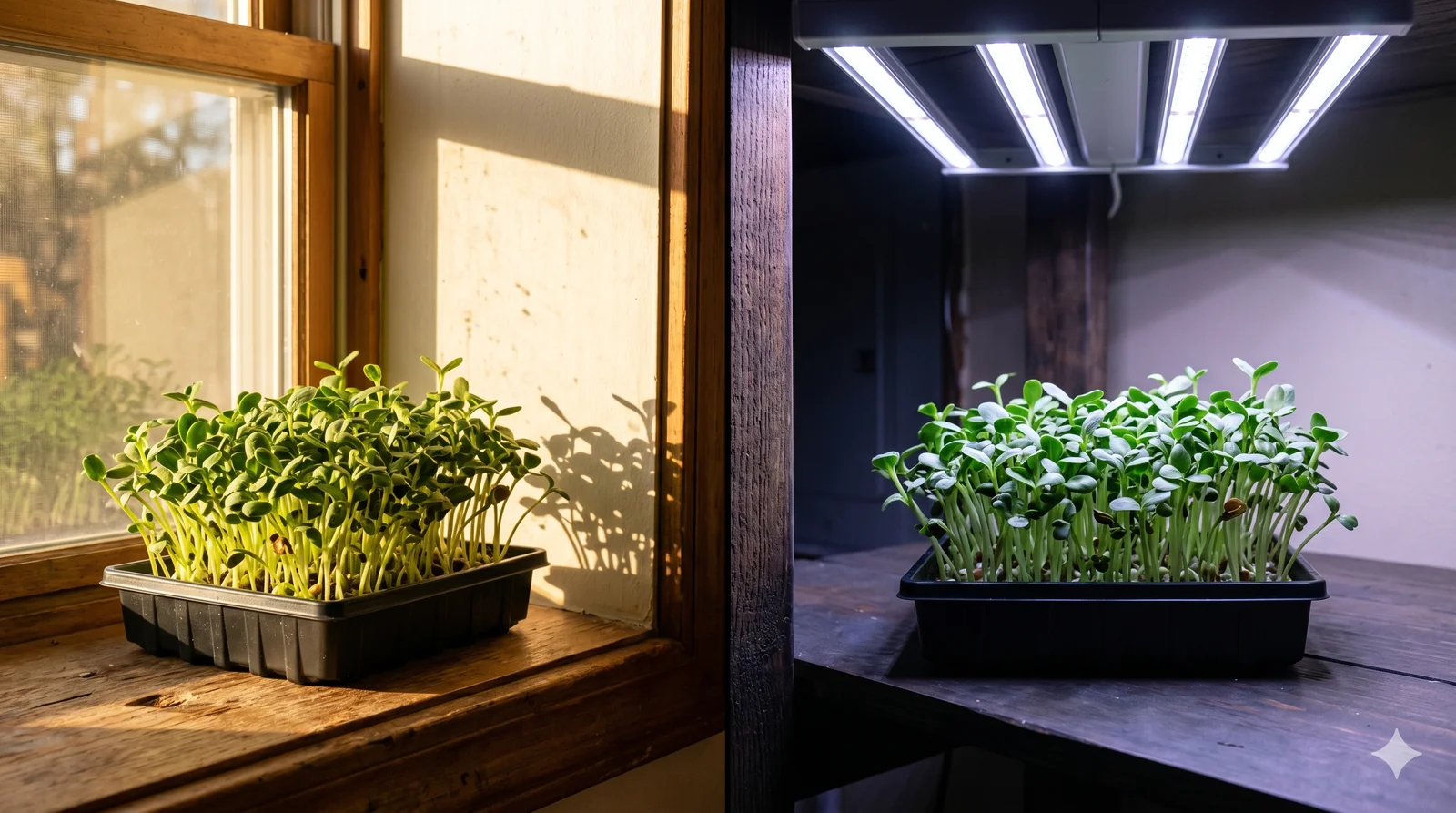
Indoor vertical farming is one of the fastest-growing segments of agriculture. Plenty, AeroFarms, Bowery, Infarm - all promise farm-fresh produce grown under LED panels in windowless warehouses, year-round, hyper-local. The marketing is excellent. The nutrition story is more complicated than the marketing admits. ☀️
The light a plant grows under is one of the biggest factors deciding what nutrients end up on your plate. After 30 years of peer-reviewed research, the science has converged on a clear set of answers - sun wins on some things, LEDs win on others, and most commercial indoor farms are quietly missing a wavelength their crops genuinely need. Here is what the studies actually show.
The Short Answer 🎯
Sun-grown vegetables accumulate substantially more anthocyanins, polyphenols, flavonoids, glucosinolates (including sulforaphane precursors), and certain carotenoids and tocopherols than plants grown under standard horticultural LEDs. The reason is simple and well-established: the sun delivers UV-B radiation, and standard LEDs do not.
Indoor LED-grown vegetables can match or exceed sun-grown plants on vitamin C, vitamin E, and lycopene in hydroponic systems with optimized light recipes, and they preserve those nutrients far better through short local supply chains. Field-grown lettuce shipped from California to Pennsylvania bleeds 50 percent of its vitamin C en route. Indoor microgreens delivered the same day do not.
The right answer for nutrient density is not sun OR LED. It is sun AND LED, with the soil and growing system to back them up. We will show you why.
What the Sun Delivers That No LED Can 🌞
The single most important fact in this debate is that almost no horticultural LED emits any photons below 400 nanometers. Kusuma, Pattison, and Bugbee published this finding in Horticulture Research in 2020 and it has held up across every commercial fixture surveyed since. Standard phosphor-converted white LEDs emit nothing in the UV range. Dedicated UV-B LEDs exist but have under 10 percent efficiency compared to over 50 percent for blue and red, and most fixture lenses absorb residual UV for worker safety reasons.
Why does that matter? Because plants do not just use light for energy. They use specific wavelengths as signals. UV-B (280 to 315 nm) is sensed by a photoreceptor called UVR8, identified by Rizzini and colleagues in Science in 2011. When UV-B hits UVR8, the protein monomerizes, binds COP1, stabilizes the master transcription factor HY5, and turns on the entire phenylpropanoid pathway - the entry point to flavonoids, anthocyanins, sunscreen pigments, and defense compounds (Jenkins, The Plant Cell, 2014).
In other words: UV-B is the trigger that tells a plant to make its own protection. Without it, the plant grows just fine but produces dramatically less of the very compounds we want when we eat it. Sun-grown plants get this signal every clear day. Indoor LED plants almost never do.
🔬 Quantitative Gap (Indoor LED vs Sun / UV-B Supplemented)
- Anthocyanins (red lettuce): +147% to +468% with UV-B
- Total phenolics (lettuce/kale): +57% to +99% with UV-B
- Glucoraphanin (broccoli, sulforaphane precursor): +73% with UV-B
- Indole glucosinolates (broccoli): +78% to +170% with UV-B
- β-carotene + xanthophylls (sun vs shade leaves, 9 species): 2-3x higher in sun
- α-tocopherol per leaf area: Higher in sun-grown leaves
Where Sun-Grown Wins 🌅
Anthocyanins and Phenolics
The single cleanest study on this question is Zhou and colleagues (2024) in PLOS ONE. They grew red leaf lettuce ('Rouxai' and 'Red Salad Bowl') under standard indoor LED, then added end-of-production supplemental UV-B for six days. Anthocyanins jumped 468 percent in 'Rouxai' and 154 percent in 'Red Salad Bowl'. Total phenolics rose 80 to 99 percent. Same facility, same cultivar, same nutrient solution - just adding UV-B was enough to triple or quadruple these defense compounds. The implication is that everywhere sunlight is naturally shining, those compounds are being produced for free, and indoor crops without UV are missing them.
A 2021 review in the Journal of the Science of Food and Agriculture by Bian and colleagues synthesized similar findings across lettuce, brassicas, and tomato: red+blue LEDs raise total phenolics, flavonoids, and ascorbic acid in lettuce by 20 to 80 percent compared to white-fluorescent lighting, but UV (absent in controlled environments) contributes to anthocyanin biosynthesis that artificial light alone cannot match.
Carotenoids and Tocopherols
Demmig-Adams and Adams published a foundational paper in Plant, Cell & Environment in 1992 comparing 9 species of sun and shade leaves. Sun leaves had 2 to 3 times higher xanthophyll cycle pigments (V+A+Z), substantially higher β-carotene, and higher Chl a/b ratios than shade leaves. Sun leaves accumulate zeaxanthin under high light to dissipate excess energy. Shade-grown leaves do not - they have no reason to.
Lichtenthaler and colleagues (Photosynthetica, 2007) followed up with the same finding for tocopherols (vitamin E): sun-developed leaves had higher α-tocopherol content per leaf area than shade-developed leaves of the same species. Light intensity and spectrum together drive these compounds. Indoor LEDs at modest intensity simply do not produce shade-leaf-equivalent levels.
The Sulforaphane Story 🥦
Broccoli microgreens deserve their own deep dive because the light science is unusually well-mapped, and sulforaphane - the cancer-fighting NRF2-activating compound - has more peer-reviewed research behind it than almost any other naturally occurring substance.
Red LED Light Boosts Sulforaphane, Blue Suppresses It
Wang and colleagues (Food Chemistry, 2021) grew broccoli seedlings under white, red, blue, and red+blue LED light at 200 micromoles per square meter per second for four weeks. Red light significantly increased sulforaphane and total glucosinolate accumulation by inducing the SOT18 gene that drives aliphatic glucosinolate biosynthesis, alongside upregulation of CYP79B2, CYP79B3, and CYP83B1 for indole glucosinolates. Blue light produced the opposite result. It depressed methionine, downregulated SOT18, and induced the BoHY5 transcription factor, which the researchers confirmed binds directly to the SOT18 promoter and shuts it down. A grow setup that is too blue-heavy will produce a less potent broccoli microgreen than one with a stronger red component or full-spectrum sunlight.
Light Intensity Has a Sweet Spot
A 2021 study in Agronomy tested broccoli microgreens at 30, 50, 70, and 90 micromoles per square meter per second using a balanced red-green-blue LED ratio. Plants grown at 50 produced the most biomass - the largest, plumpest microgreens by fresh and dry weight. But plants grown at 70 had the highest content of glucosinolates, vitamin C, flavonoids, soluble protein, and free amino acids. There is a real trade-off between maximum size and maximum nutrition. Industrial growers chasing only weight may unintentionally produce a less potent product.
UV-B Drives Glucoraphanin and Indole Glucosinolates
Moreira-Rodriguez and colleagues (Molecules, 2017) treated broccoli sprouts with UV-B and harvested 24 hours later. The results: 4-methoxy-glucobrassicin up 170 percent. Glucobrassicin up 78 percent. Glucoraphanin (the direct sulforaphane precursor) up 73 percent. Mewis and colleagues (Journal of Agricultural and Food Chemistry, 2012) found that low-dose UV-B at 1.5 kJ/m² upregulated CYP79B3, the key enzyme for indole glucosinolate biosynthesis, by 6-fold.
Sun-grown broccoli accumulates more of these compounds for free, every single sunny day. Indoor broccoli only matches it if the grower deliberately installs UV fixtures, which almost no commercial vertical farm does. This is the single biggest nutritional gap in conventional indoor microgreen production, and it is a gap most consumers do not know exists.
🔬 What the Sulforaphane Light Studies Found
- Red LED: Induces SOT18, raises sulforaphane and aliphatic glucosinolates (Wang et al., Food Chemistry, 2021)
- Blue LED: Activates BoHY5, suppresses SOT18, lowers sulforaphane (Wang et al., Food Chemistry, 2021)
- 70 µmol/m²/s: Optimal intensity for glucosinolates, vitamin C, and flavonoids in broccoli microgreens (Agronomy, 2021)
- UV-B treatment: +73% glucoraphanin, +78% glucobrassicin, +170% 4-methoxy-glucobrassicin (Moreira-Rodriguez et al., Molecules, 2017)
- Sunlight UV-B: Naturally delivered every clear day. Standard LEDs emit zero photons below 400 nm (Kusuma et al., Horticulture Research, 2020)
Where Indoor LED Wins 💡
The picture is not all one-sided. Indoor LED has real, measurable advantages on specific nutrients - and being honest about them matters.
Vitamin C and Vitamin E in Hydroponics
Buchanan and Omaye published in Food and Nutrition Sciences in 2013 that hydroponic indoor lettuce had over 90 percent more ascorbic acid than soil-grown lettuce under matched greenhouse conditions. Tocopherol (vitamin E) was also higher. Treftz and Omaye found the same pattern in tomatoes, spinach, and strawberries: hydroponic indoor systems with controlled nutrient solutions outperform soil-grown counterparts on these specific vitamins.
Lycopene with Intra-Canopy LED
Appolloni and colleagues (Scientific Reports, 2024) added intra-canopy LED supplementation to greenhouse tomato plants growing under sunlight. Result: +31.3 percent lycopene and +123.4 percent vitamin C compared to sunlight alone. This is a case where supplemental artificial light, layered onto natural sunlight, beats either source on its own.
Postharvest Freshness Premium
Lee and Kader's 2000 review in Postharvest Biology and Technology remains the authoritative reference: vitamin C losses of 50 percent or more occur within days at retail temperatures. Spinach loses about 29 percent of its ascorbate after just one day at 4°C. Field-grown produce shipped 5 to 12 days from California to the East Coast bleeds vitamin content during transit. A microgreen harvested locally and delivered the same day does not. For vitamin C in particular, freshness can offset the spectrum disadvantage entirely.
Year-Round DLI Advantage at Northern Latitudes
Ahmed and colleagues (Scientific Reports, 2023) showed that northern-latitude winter greenhouse daily light integral (DLI) often falls below 5 mol/m²/day - far below the 12 to 17 optimum for lettuce. Indoor LED can hold optimal DLI year-round. Above 40°N latitude, indoor LED actually exceeds the available natural sunlight for much of the year. Pure outdoor sun is not always an option.
The Honest Caveats ⚖️
Most "indoor vs field" studies confound multiple variables - cultivar, soil vs hydroponic, harvest age, postharvest delay all differ simultaneously. The cleanest single-variable studies (like Zhou 2024 adding only UV-B) are the rigorous ones. Many headline-grabbing claims rest on cross-study comparisons against USDA database means, which is methodologically weak.
Industry claims also need discounting. AeroFarms' "35x higher nutrient density" press releases compare microgreens to mature broccoli heads (an unfair compositional comparison) and are commissioned, not peer-reviewed. Plenty, Bowery, and Infarm publish almost no peer-reviewed nutrient data - a notable evidence gap for companies built on the implicit promise of better nutrition.
The Xiao 2012 finding that microgreens have 4 to 40 times the nutrients of mature plants is real - but it compares life stages, not light sources. An indoor microgreen and a sun-grown microgreen would be the truer comparison. When that comparison is run rigorously, the sun-grown microgreen tends to win on phytochemical density.
Why microGREEN FX Uses Both Sun and Artificial Light 🌞💡
We took the research seriously and built our farm around it. Our microgreens grow under both natural sunlight and supplemental artificial light - not one or the other. Sunlight delivers the full solar spectrum, including the UV-B that triggers the UVR8 photoreceptor and drives glucoraphanin, anthocyanin, and polyphenol biosynthesis. Supplemental LED gives us consistent daily light integral year-round, including through cloudy stretches, short winter days, and the latitude reality of Southeast Pennsylvania, where winter DLI alone is not enough.
The two together push our microgreens harder than either could alone. Sun for the defense compounds and full-spectrum signaling. Supplemental light for consistency and intensity in every season. The peer-reviewed research backs up every part of this approach.
The Soil Half of the Equation 🌱
Light is half the story. The other half is the root zone - and most microgreen farms cut corners there too. Walk into nearly any commercial microgreen operation and you will find the same commodity coco-coir or peat-heavy mix pulled off the same wholesale pallet. We blend our own.
MicroThrive Soil is our proprietary peat-free, petroleum-free living blend, built from scratch and refined tray by tray over years of commercial production. It is engineered specifically for the way microgreens take up nutrients during their short, intense growth window. Healthy soil makes healthier plants, and healthier plants make more of the defense compounds the light science tells us to want. Light and soil work together. Cut corners on either and the final nutrient content suffers.
Combined with our beyond-organic sourcing standards (we earned USDA Organic certification in 2022 and chose not to renew heading into 2025 because our internal standard exceeds what the certification requires), this is what goes into every clamshell. Sun and supplemental light. MicroThrive Soil. Stricter-than-organic seeds and water. And a family that eats what we grow before it ever leaves the farm.
Get microgreens grown the way the science actually says to grow them. ☀️
microGREEN FX microgreens are grown under both natural sunlight and supplemental light, in our own peat-free MicroThrive Soil. No commodity coco-coir mix. No windowless warehouse. No UV-B-deprived crops. Just real food, grown right.
Bottom Line 📌
The defensible scientific position is this: sun-grown plants accumulate substantially more anthocyanins, polyphenols, flavonoids, glucosinolates (including sulforaphane precursors), and certain carotenoids and tocopherols than plants grown under standard horticultural LEDs. The UV-B that triggers the UVR8 pathway is the single most important factor, and almost no commercial indoor farm replaces it.
Indoor LED-grown vegetables paired with hydroponic systems and short local supply chains can win on vitamin C, vitamin E, lycopene, and freshness. They cannot match sun-driven phytochemical density without explicit UV-B supplementation, which almost no commercial vertical farm uses.
The right answer is to use both. The sun for what only the sun can do. Supplemental light for consistency. The right soil to support both. And a farmer willing to do the harder work because the science says it matters.